
After the summer break, we bring you an unabashedly provocative and controversial piece about what the author claims is a set of essential tools to survive the wave of doubt and apostasy facing Muslims in the West.
Essential and worrying reading.
A major event in world history went largely unnoticed by Muslims both in the West and elsewhere recently – namely the legalisation of gay marriage in Ireland, which, rather than the Vatican, is in fact the citadel of Catholicism in the West. Moreover, this occurred with the full consent of a significant majority of the population (over 60%) in a democratic referendum (unlike the recent liberalisation of marriage laws in the US, which essentially was pushed through a form of constitutional court after losing referenda in states such as California). My point here does not concern the merits or demerits of gay marriage, an issue that is wont to send both Liberals and the religious into conniptions, but rather to illustrate that despite the clear teaching of the Catholic Church on the very act of homosexuality let alone its institutionalisation, and the fact that the vast majority of the Irish did and would still describe themselves as Catholic, with some of the highest Church attendance in the Western world (which, granted is not saying much as congregations dwindle in developed countries year on year, with catastrophic declines in the UK and other European countries in particular), yet in little under five years the Gay Marriage lobby ‘won’, in the sense that there is no more way to justify homosexual unions in the Catholic tradition than there is to justify a ban on contraception or anal sex in the secular liberal canon. The point is that the secular liberal contingent was able to deal the Catholic Church what will one day come to be seen as a catastrophic blow in its stronghold. Among the many explanations that have been proffered, from the de-legitimisation of the Church due to child sexual abuse scandals (although non-religious people abusing children or adults is strangely never seen as a jumping off point to criticise atheism or agnosticism) to the inevitable march towards progress that secularism is alleged to bring, none are truly sufficient to explain the remarkable turnaround in so short a time. Catholic authorities in Ireland now know that they will be challenged on abortion next – and if they are realists, can expect a similar reversal.
Muslims have observed this, if indeed they have bothered to observe it at all, with a kind of detached bemusement. Many Muslim speakers and intellectuals (and I use this term in its loosest sense) have indeed seen the rise of ‘Gay Rights’ as a Godsend that allows them to emphasise the alleged decadence of the West. It escapes them that Catholic commentators were doing much the same a few years back. Too busy playing to the gallery as opposed to ‘preaching to the perverted’, they were left adrift as public opinion changed or was manipulated against them in the meantime. While Muslim speakers see it as self-evident that gay marriage is ‘wrong’, their congregations in wider society struggle to furnish any convincing arguments against it, and soon may not even be allowed to do so as disapproval of gay marriage is increasingly conflated with homophobia and can lead to serious censure.
Unlike Muslims, Catholics have retained a lot of their intellectual traditions, not rushed to incorporate Protestant movements (as Muslims have by giving up the field to Salafi and Wahhabi groups) and maintain an number of gifted thinkers and philosophers on their books, both now and in the recent past. A comparison for example of the Jesuits and the vile output of Medina University is perhaps illustrative of this point. But neither this nor the organisation, financial clout and centralisation of the Catholic Church was of any use against the arguments/propaganda/tele-evangelising of the Liberal contingent.
The question that arises is that if the liberal media complex can eviscerate the Catholic Church in the space of under a decade in its Western stronghold, what can it do to the Muslims when it turns its attention to them?
Whereas for much of the recent past, Muslims have been relatively ‘under the radar’ (save for places such as the USSR where they were subjected to sustained academic/educational system and other attack, resulting in mass apostasies if Soviet statistics are to be believed[1]), since 9-11 the aggressive actions of both international terrorists as well as Muslim apologists and ‘Dawah’ organisations have directed the eyes of Secular Humanists and Liberals towards Islam. Having suitably hammered both the Catholic and Protestant Churches in the last two Western societies where they still enjoy any influence (Ireland and the United States respectively), one can safely expect that ‘they’ will now turn their attention more fully towards Islam.
They will find an easy target: even in the United Kingdom, Muslim communities are under educated and under financed. Groups such as IERA who feign to represent Muslims on campus have been unable to furnish a single tenured professor or even a PhD candidate in over six years of (very well-funded) action. Atheists and Islamophobes will be looking on in glee: debaters and ‘activists’ such as Hamza Tzortzis speak to under and post graduate crowds but quite apart from not having any academic qualifications to speak of, IERAs’ years of preaching ‘Big Bang Cosmology’ has not seen it actually recruit or train or even sponsor a single actual cosmologist. There is much to be said for gifted amateurs (and sadly, IERA are not those either), but the fact is that all the talk of ‘science in the Quran’ and the ‘Big Bang’ (whose overuse by theists in an often non-rigorous fashion has no doubt contributed to the clear trend amongst physicists to try and get rid of it from their models entirely by emphasising ‘Eternal Inflation’ and the ‘Big Bounce’, which are essentially the eternal universe rehabilitated) is not actually resulting in a) any scientists converting to Islam and joining Salafist Dawah organisations or b) any Muslims mastering the discipline of Cosmology. This is blood in the water for both militant secular humanists and scientific atheists.
There are degrees of survival that Salafist organisations are willing to accept however: after exposing Muslims to the full brunt of the above groups’ wrath, they will be happy to not bother with debating anymore and to retreat, like Evangelical churches in the US, to their congregations of the already convinced (but increasingly irrelevant). Since virtually all groups representing Muslims are Millennial and essentially nihilistic, seeing changes in society as signs of ‘fitnah’ (trials and tribulations) and the ‘End Times’, they are frankly not too bothered with what goes on in larger non-Muslim society or even with Muslim apostasy, as this fits nicely into their world view in any case. In this, they share much in common with the Evangelical Christians and the idea of ‘The Rapture’. In fact, they both share the idea of a large segment of humanity being wiped out and true believers being rescued by Jesus Christ.
Essentially, such groups will put religious believers in the line of fire but when things don’t go well, they are happy to retreat and decry the ‘Age of Darkness’ we have (according to them) found ourselves in. They will try to argue and convince people but not very hard and when the going gets tough they will, in effect, run away and await their version of The Rapture. These people are present in all religions and amongst those with none: Lenin’s body is soon to be buried but it was meticulously preserved by his followers to await his scientific resurrection. Everyone has a version of a ‘better tomorrow’ or an unrealistic utopia.
Christianity may not seem to Muslims to be a good example but in this they are again mistaken. Although the defeats in Ireland and the United States are just the latest in a protracted process of increasing secularisation since The Enlightenment and before, many Christian thinkers have long realised that the Church had overplayed its hand in political meddling, self-interest at the expense of doing what was right (for example, during the Second World War where one could find the church effectively praying for the victory of both sides), social engineering and tampering in family affairs as well as oft-lamented anti-rationalism and textualism. All of these problems afflict Muslims too, though they have less insight than most Christian thinkers. Wont to look down on their Christian brothers, Muslims often suffer from hubris while having exactly the same gaping holes in their world view and theology.
Take the doctrine of the Incarnation of God or the Trinity. I witnessed the truly tragic exchange of a Salafi mocking a Christian about the doctrine of God being present in the body of a man, the dual natures of Christ as both God and man and whether the Trinity made sense. The problem with this was that the Salafi, much like many of the currently dominant groupings of Muslims also believes that God inheres in a body, and anathematise Muslims who reject the anthropomorphic descriptions of God found in some narrations accepted by them (such as of Adam in the image of God or God appearing as a beardless young man[2]). Needless to say, even the Christian, who presumably by his own admission is an anthropomorphist, went to town on this fellow: ‘so you agree God is a body, you just don’t agree he is Jesus’ body right?’ He then challenged him on the well-known Hanbali/Salafi assertion that God is literally sat on or above the throne (fortunately for the Salafi, the Christian was unaware that Salafis also consider that Muhammad will be sat next to him, much as Jesus is said to sit on the right hand of God in the Bible). ‘So God sits on the throne, and comes to Earth in the last part of the night[3]? So that means he enters the creation right? So why can’t he enter Jesus? Jesus is better than the throne or all of the Earth isn’t he?!’
And indeed Jesus is better than ‘The Throne’ and the whole world according to Muslims. The poor Salafi was visibly perspiring. I felt terrible. Here was a man being led to apostasy by a fellow anthropomorphist: what would an atheist, a logician, a philosopher or a Mu’tazzilite, who could attack the very concept of a God that is bound by space, time or a body do to him?
The problem was of course that the Salafi and the Christian in fact both have the same belief – namely that God is a body and can enter the universe and incarnate – they just disagree as to how and when. Of course, the Salafi replied with the tried and tested trope that God is on the Throne or comes to Earth but ‘without a how’. Which is exactly how Christians explain how Jesus can be both God and man or that the Trinity can be consistent with monotheism. ‘Without a how’ is Salafist speak for ‘I don’t know. It doesn’t really make sense. Don’t ask me about this’.
But of course, atheists and others will ask. In the example above, I could easily see a minor philosopher, even of the theistic variety, divesting both of them of their faith.
Muslims’ feeling more secure than other religious groups who have suffered a wave of apostasy when encountering Western Civilization or ‘the Monoculture’ is very dangerous for their future prospects. In addition to the problems with the concept of God that were highlighted by the combative Christian, Muslims have a number of social issues that are unique to them which are not shared by Christians: Christians have no challenges in terms of explaining their dress code or social interactions with women (at least not most Christians, although there are groups that do maintain Old Testament dietary and dress regulations, for example the Mennonites, at least in part). The great danger is in fact that many lay Muslims are labouring under the misconception that Muslim scholars and apologists from Yusuf Al Qaradawi to Zakir Naik can answer the questions they can’t and somehow ‘save’ them from problems. This is a colossal error and a tragic case of misplaced faith. The results of this are already being seen: scholars who have both good knowledge and can transcend their sectarian, or increasingly, Saudi-funding basis, are very hard to come by indeed. Scholars which have the necessary grounding in either science or philosophy are also next to impossible to come by. The self-satisfaction of practising Muslims who are ‘students of knowledge’ quickly evaporates with even a cursory session online where they find their interlocutors failing to even defend the authenticity of the five daily prayers against poorly read Islamophobes.
For some Muslims this will be a terrible shock from which they will not recover. For most in today’s world, exposed to ideas instantly and in doses which would hitherto be considered dangerous, there is only limited time to have their doubts answered before the dominant social and intellectual paradigms fill the void left by Muslims intellectual incompetence. Those Salafists telling their followers that applying the intellect is ‘haraam’ (prohibited and immoral) and is the way of the Mu’tazzila (early Islamic rationalists) will not last long against the plentiful engines of apostasy online and in daily life who are advocating that the person use his mind as much as he likes, much as throughout history the argument for celibacy has always, in the end, lost to some form of permissiveness, even if not unrestricted.
Another compounding factor is Muslim leaders persistent refusal to admit the actual causes of Muslims’ confusion and apostasy (in fact, it is next to impossible to get them to admit that there even is a problem, so fond are they of repeating the Islamophobes baseless assertion that Islam is ‘spreading’ in the West and that there are numerous converts). Groups such as Deobandis, Salafis and Brelwis are singularly unable to admit that it is many of the same hadith that they insisted were in fact uttered by The Prophet (to the point of anathematising those who disagreed) that are now causing many to leave Islam. For other groups such as HT, it is the refusal to admit that their emphasis on an ‘Islamic’ state and kowtowing to anyone who claims to furnish this (from Khomanaie to the Taliban) that causes many to become disillusioned with the utter inadequacy of the realisation of this concept and the disparity between those states and the quasi-mythical image of the ideal state portrayed by HT itself. They have learned their lesson by not openly supporting ISIS, but in fact are now further confusing their desperate adherents by not following a state which actually bases all of its rulings on the same textual and juristic sources that HT used to alienate Western Muslims from their host countries and justify the concept of an Islamic State in the first place. They essentially use fatwas, opinions and hadith from the same people that ISIS did but find the conception of the ‘Islamic State’ politically inexpedient or embarrassing and so try to backtrack in a manner that convinces no one of even average intellection that ISIS is not in fact an authentic realisation of their goals.
Likewise, as many have begun to realise, the reliance of the Salafi dawah (‘inviting’ people to Islam) movement on ‘science’ has in fact encouraged a type of militant scientism in their followers and has led to their suffering the same disease as Western proponents of that idea: regarding science as an ultimate end and an omni-competent tool for truth. Although such a world view sits very nicely with both the western Scientific and Salafist anti-philosophy bent, it leaves the latter uniquely unarmed to even articulate let alone defend their faith – especially against scientists. They are also leaving themselves open to a catastrophic refutation since despite all of the harping on about science, they are in fact textual literalists and will not in fact reject something from the hadith literature that conflicts with scientific research, resorting to a series of fudge tactics such as ‘science hasn’t explained this…yet’. These convince no-one, not even themselves most of the time.
Everyone has an angle. And if it is their angle that is causing the problem, they will never even admit it let alone resolve the issue.
My goal here is in the spirit of honesty exemplified by Jeffrey Lang in his latter day masterpiece ‘Losing My Religion’, in which he sought to honestly tackle those issues which he actually found causing doubt and apostasy amongst Muslims (as opposed to what he would like to be the case). Of course, people will object that there is no apostasy, these are not the reasons, it is empirically impossible to show that it is in fact these ones etc. That is fine by me. My aim here is simply to provide a roadmap, in its general outlines, of the methodologies, ideas, fatwas and leeway – the ‘tools’ if you will, that ordinary Muslims in the West or anywhere else for that matter, will require in the coming decades to hold on to their faith. It is my subjective perception of the problems they are already facing and will increasingly face and how best to circumvent them. It is not a detailed verse by verse apologia but rather a description of those attitudes of mind which if held may enable one to avoid the worst travails without necessarily having in depth knowledge of specifics. For example, unlike the majority of rather ineffective yet confusingly long and convoluted ‘explanations’, I won’t be trying to explain individual problematic hadiths or juristic decisions. Rather I will be trying to encourage an attitude or epistemology towards these that can enable one to avoid doubts in principle.
Of course, I am sure that my ‘toolkit’ will offend most sectarian and entrenched interests and raise their ire, but that is of no consequence as neither I nor any moral being can sacrifice the needs of many to lionise or safeguard the sensibilities of the few or the powerful. As it is with the financial 1% in the West, Islam has unfortunately acquired a religious or cultural ‘1%’ who disseminate and insist on their ideas often in contradiction to any evidence to the contrary, whether from the Quran or the lived lives of Muslims and others. I encourage readers to challenge the attitudes and prejudices of this ‘Islamic 1%’ and judge for themselves what is or is not the coherent and Islamic teaching on a particular subject.
Lay Muslims Need Free Deniability of Any Single Chain Hadith – i.e. Most of Them
Much of the fanaticism of the Salafist and Salafi inspired groups mentioned above is directed at defending the canonicity and authority of the hadith literature. Unlike the Quran, which in English translation is around six hundred pages, the hadith literature is an astonishingly complex conundrum of over two million narrations of wildly varying thematic content and believability. Sunni and even many Shia efforts have largely been directed at defending a ‘final redaction’ of these narrations in six canonical Sunni collections and in particular that of ‘Sahih Bukhari’ or ‘Al Kafi’ or parts thereof in the Shi’ite case of the ‘Akhbareen’ (roughly equating to the Muhaditheen of the Sunnis). The reasons for this are very complex and wide ranging and of varying legitimacy[4] but the position that nearly all Muslims groups extant today, from sects, juristic groups to Salafists such as Ikhwaanis and HT as well as Wahhabis find themselves in is that they have painted the redaction of Bukhari as final. The problem is that their opponents are now holding them to this indefensible position. Furthermore, Muslims have managed, through the prominent post-colonial Salafist organisations and groups such as the non-violent Tablighi–Jamaat through to wannabee genocidal militants such as ISIS, so successfully to inculcate in lay Muslims the idea that hadith in general and hadith in Bukhari in particular were in fact incontestably uttered by the Prophet himself, that when they hear hadith such as that the Prophet attempted a sexual assault on a captive woman or ordered no punishment whatsoever for the killing of non-Muslims, sanctioned the assassination of a single mother who mocked him or indeed said that the sun bows to the throne of God before rising again, they never stop to consider that these narrations are misattributed nonsense. Deviant groups who have come to ascendancy within Muslims themselves have so successfully conditioned the response [hadith = word of the Prophet] that instead of scepticism about whether the Prophet actually said this, we find in the main only two responses: doubts compounded by successively controversial and unacceptable attributions to the Prophet until there is the hadith that breaks the adherents faith and he apostates or in the better and more common scenario, the Muslim is sent scurrying to the scholars (or more commonly, the internet) to explain the hadith (which of course, he just like the apostate, is convinced was indeed uttered by Muhammad). I do not have time here to go into the varying standards of ‘scholars’ (or indeed dawah ‘experts’ or apologists and debaters) explanations of controversial hadith[5] except to say that in the vast majority of cases they will be seen to be both dishonest and abysmally poor. This also goes for the attempts made by many, such as Yusuf Al Qaradawi, to explain away hadith which deal with the killing of non-Muslims. An Azhari Salafist with admittedly impressive depth of knowledge, his attempts to refute ISIS’ use of these narrations was astonishingly poor[6], consisting like most such enterprises of accepting both the controversial hadith and then presenting others (usually not from Bukhari or the canonical six books of Sunnis) to contradict them. This can be called ‘rejecting with acceptance’ but it simply leaves many onlookers of any religious affiliation confused and concerned, and with good reason.
The actual end point is that some will be so shocked by certain narrations or rather the cumulative effect of numerous narrations they find unpalatable, that they will apostate, often quite vocally (hence it becomes easy to paint these people, who often then uncritically accept secular liberal or humanistic thought without the degree of critical thinking that they applied to Islam, as self-hating stooges of Islamophobes). Many of the genuinely intelligent and critical thinking people will in fact not make a song and dance about their apostasy nor try to bring harm to Muslims (which is a fashionable passtime for uncloseted apostates too, as individuals such as Maajid Nawaaz seem to be). They simply quietly leave the faith – which is a great outcome for Muslim groups since they can overlook these individuals and a terrible one for Islamophobes because they cannot exploit them. For those who seek to explain away these narrations while accepting them, there is in my opinion, only the chance of the most worryingly gullible and wilfully blind people accepting the explanations proffered. Even in these cases, doubts often remain that can later precipitate a crisis.
Of course, it is in the interests of the ‘don’t ask don’t tell’ methodology used by most Muslim sects on this issue that it be assumed that there is no problem – and the use of these narrations is quietly minimised by most of them: Deobandis and Brelwis are very proud of having their seminarians do a ‘khatam’ or complete reading of ‘Sahih Al Bukhari’. But their ability to ignore all of the problematic narrations is perhaps much more impressive.
This attitude of self-editing and putting out fires or more often letting them burn themselves out has become slowly untenable since 9-11 and culminated in the ISIS crisis. Muslims have widely denounced the self-publicised actions of ISIS, most famously taking female captives as slaves, killing Muslim and non-Muslim captives by burning them and throwing a man who was supposedly gay off of building to his death (which they in fact failed to do so he had to be thrown off repeatedly)[7] as well as the perennial favourite of those who claim to represent ‘sharia’ everywhere – stoning someone to death for adultery. Another article has already convincingly addressed that unfortunately there are many in the Muslim community who in fact do not have an issue with these actions[8] but others have vocally denounced them also. The problem of course is that ISIS are quite justifiably vocal that their actions are justified by narrations attributed to the Prophet (burning apostates, flinging gays and mistreatment of prisoners are all found in Bukhari in precisely the manner that ISIS ‘scholars’ claim they are). Therefore it is harder for Muslims to ‘explain’ anything, at least while staying within the lines they have drawn for themselves: if they proffer a convincing explanation or resort to the understanding of those groups that they anathematised, they will become ‘hadith rejecters’.
As has been rightly said: those who can make you believe absurdities can make you commit atrocities.
Since controversial hadith are used by both Evangelical and missionary groups, Islamophobes and deviant Muslim groups to corrupt the faith and freedom of Muslims, it is not unreasonable to posit that an agnostic or ‘deniability’ attitude towards the hadith be a powerful tool for lay Muslims. All controversial narrations are single chain reports (apart from a few which are claimed by Muhaditheen as being ‘Mashoor’ or ‘famous’, such as stoning for adulterers). The Sunni and Shi’ite consensus on these (as well as that of the Mu’tazzilites and many other groups) is that they do not constitute certain knowledge. Even the Hanbalis have been subdued to this position over time. Since these are, and there is no way around this, speculative reports and may not have been uttered by The Prophet of Islam, is it not more useful to have this knowledge at the front of lay Muslims minds to prevent the vicissitudes of doubt that being accosted with a controversial narrations (admittedly often out of context or poorly translated) could cause? Instead of having to get doubts and run off and research each and every narration, an indulgence unavailable to some, is it not better if the aggressive Islamophobe or Evangelical Christian is simply silenced by saying ‘This is a hadith. We are not sure if the Prophet even said this. I no more blindly accept speculative reports that make no moral or other sense than you do, so why are you challenging me on this? Do you accept everything outside the Bible that is attributed to Christianity or Jesus for example?’
Such a stance would find much support in the classical sources, which described a hadith which is graded as ‘sahih’ as only potentially correct or ’50:50’. The reason for this was not to facilitate deniability or apologia but rather that considering narrations with single or a few sources documented two hundred years or so after the passing of the Prophet as ‘certain’ was never a tenable position and had been thoroughly criticised by many groups, including those extant today such as the Malikis and Hanafis. Put bluntly, arguing that Atlantis exists because Plato possibly had some chains of reliable narrators and documented it is not a position that Westerners would find credible. And the same goes for Muslims through much of history.
But the present day obsession with hadith by Salafis, Deobandis et al, often to justify their sectarian, isolationist and violent agenda or heretical theology as opposed to for reasons of genuine religious practice or even historical authenticity, has meant that hadith are grossly over emphasised and although most of these groups are forced under theological pressure to admit that the hadith, including those of Bukhari, are not all authentic and are indeed speculative knowledge, they resort to a second tier of blackmail if one can indeed get them to admit even this: namely that it is sinful to reject them without a reason, the consensus of the scholars, that everyone accepts them except deviant group ‘x’ and so on. In effect, this is just a backdoor way of again insisting on all sahih Hadith as certain knowledge again. As an adjunct, these groups often threaten individuals with the danger of ‘rejecting the words of the Prophet based on your own deficient intellect’. Quite apart from the fact the question is whether the Prophet actually said these things in the first place and that one’s own ‘deficient intellect’ is all one has to make any kind of decision anyway (including delegating ones thinking to others), this is a bizarre inversion that, if the recipient is intelligent, will actually speed apostasy: in effect, these people are saying that Muslims accept things that do not make sense to them because they allegedly make sense to someone else more knowledgeable to them. One wonders how they would apply this logic to the doctrine of the Trinity or the existence of God. Would they advise a Trinitarian or a polytheist not to think about these doctrines and leave it to their more knowledgeable scholars? If not, then what we have here is a case of manifest hypocrisy.
Most of the groupings in the past put restrictions on who could and could not reject sahih hadith, but given the paralysis (often induced by the desire for speaking engagements and Saudi money) amongst most who claim to represent Islam today when it comes to rejecting those narrations attributed to the Prophet such as those above, as many Muslims, notably the Hanafis, Malikis and Mu’tazzilites did in the past, today we have no choice but to empower the Muslim laity to question those hadith that conflict with their personal conscience and intellect. And if the scholars cannot furnish a suitable explanation, then to reject them without undue concern. As for the alternative, we are already seeing its dire consequences.
The Sanctification of the Scholars Must Stop
If Muslims and their supporters are in dire need of returning to the classical methodology of those who did not take Sahih hadith as ‘gospel’ – since people can and do attribute calumnies to the Prophets – then how much more so with the ever more fallible scholars? Although Shi’ites are famous for having seven or twelve ‘infallible’ imams, Sunnis in fact have hundreds. Authorities ranging from outright heretics such as Ibn Taymiyya through to more genuine ones such as Imam Shafi are considered beyond reproach. Or more accurately, beyond reproach by those same lay Muslims who are going to be exposed to doubt due to hearing their opinions. Muslim readers will be instantly familiar with the analogy of a doctor which is wheeled out by Salafis, Deobandis and Brelwis along with too many others to mention with nauseating regularity to explain this unquestioning deference to scholars.
You are sick, so this false analogy goes, and you go to a doctor to help you obtain a cure. Since you lack knowledge, you defer to his superior knowledge and trust him to help you get better. And thus with Muslims scholars, up to and including your local imam. Quite apart from the fact that this ‘analogy’ is completely incoherent since one freely chooses which doctor (or none) to go to, it makes no sense at all since one might follow one’s doctor in taking a mild painkiller for an inflamed joint, but if the same doctor asked one to undergo castration to avoid the inconvenience of nocturnal emissions and soiled bedsheets, one would in no way defer to his admittedly superior medical knowledge. That is because the degree of deference, or in Islamic terms blind imitation or ‘taqleed’, is directly proportional to the existential consequences of the particular course of action to be imitated unquestioningly. One would have assumed that this was a piece of what is (perhaps ironically) known as ‘common sense’, but this understanding has entirely evaporated from many Muslims.
I recall when I first started to seriously study Islam as an undergraduate at university. My instructor was a scholar from the Shafi School. It was all going swimmingly until he came to the (to put it mildly) ‘idiosyncratic’ opinion of the Shafis, which they trace to Imam Shafi himself, that if one has an illegitimate daughter, she was in fact not ones’ daughter. And so one could marry her. The response of a young convert in the class was actually what should have been my own: ‘Dude, what the hell?!’ he cried out loud. But rather than join the chorus, despite my, err, surprise at this information, I turned and reprimanded the other student, first of all for swearing and even more so for disrespecting the opinion of Imam Shafi. It is shocking to me now that I did this but so conditioned was I to uncritically defer to the opinion of scholars and so convinced of the infallible and unassailable opinion of Imam Shafi, who I was brought up by Islamic teachers in madrassa to consider virtually as unquestionably right as the Prophet himself, that my deference to him, temporarily at least, overcame my aversion to incest. Needless to say, my response and the approval of it by the teacher must have given the poor convert a very effective push on the road to apostasy. ‘I’ve joined an insane cult’ he must have been thinking. And he was right. But it wasn’t a cult of Islam but rather one of uncritical devotion to the opinions of (certain, select) scholars.
Recently, the bizarre opinion of Imam Shafi was being defended by a Muslim in a group discussion where it had been raised. An (allegedly) ‘modernist’ Muslim interjected and said ‘Shafi was talking rubbish. Islam would never allow you to marry your biological daughter. Arguing that a daughter born out of wedlock is not actually your daughter at all is mental’. I said nothing. I had learnt my lesson: the reputation of Islam and religion was more important than the reputation of Shafi by some infinity of degrees. I thought the interlocutor was harsh and rude. But if Imam Shafi really said that (and it seems he did) then he ‘messed up’. Badly.
The fatwa of Imam Shafi on marrying ones daughter is an extreme example, but it is illustrative of the legion of bizarre, dangerous and morally bankrupt opinions attributed to the famous scholars of Islam. Many of these are questionable but many others also certainly were uttered by them. And of course, they can cause huge doubts. In the case of the hadiths which caused doubt, the concern of Muslims was above all to salvage the authenticity of the patently fabricated hadith, to hell with the doubts of the lay Muslims: they lacked the necessary ‘faith’. Although it is unclear what level of ‘faith’ is required to have sex with one’s sister or daughter as some Shafis are implying, in the case of scholars opinions, it is again the concern of various apologists to salvage the reputation of the scholar in question or cry misattribution (no matter how implausible). This is of course if they do not, as my teacher did, simply defend the position.
Of course, both of these methods have merit: we do not want to throw out the baby with the bathwater and become ‘radicalised’ against Shafi if he did not in fact say this or if it was taken out of context etc (it isn’t unfortunately). Nor do we want to disregard the ‘good stuff’ he said on account of an error. The point is that errors should be called as such and that Muslims need deniability in the case of the opinions of the scholars, which is in this instance even more obvious and part of traditional Islam than it was for hadith, to protect them from needlessly questioning their faith because some followers of Shafi didn’t question something he probably didn’t say in the first place or because we have an unhealthy obsession with certain authorities (it is interesting to note that with many exceptions, these scholars, including famous Imams such as but of course by no means limited to Shafi, Malik, Al Ghazzali etc would criticise each other in the most disrespectful terms). My point is that lay Muslims are taught to defer to a group of people that did not in fact extend this courtesy to each other. Of course, the excuse is their superior knowledge but the argument that I need knowledge equivalent to Shafi to critique him on the issue of marrying my own daughter or know as many hadith as Ahmad to critique him on the issue of killing non-Muslims or women or children without punishment is patently idiotic, much like asserting that until I have am in depth working knowledge of Quantum Mechanics I am not to say that the Manhattan Project was a bad idea for humanity. Maybe this line of reasoning worked once, but today it is an Achilles Heel of epic proportions.
With many sects extant today, there is the added motivation that if people are free to exercise ‘deniability’ with regards to some of the famous Imams, this leaves their own founding fathers in a tight spot, as one finds increasingly disturbing and un-Islamic fatwas emanating from later Imams and especially from the founders of the popular post-colonial movements today such as Deobandism (for example, the works of Ashraf Ali Thanwi), Ahmed Ridha Khan and Brelwi’ism, Sayyid Qutb and of course the perennially moronic Ibn Abd Al Wahhab. If people are not too accommodating of Ahmad or Shafis’ stranger narrations then how much less so for these individuals, so their adherents seek to nip the problem in the bud and enforce a general ‘argument from authority’, despite the fact that even God failed to use this form of persuasion when he was questioned by Satan or the Angels, opting instead for rational and even empirical proofs[9].
Another misconception of Muslim scholars that helps speed people on the way to apostasy is that their (chosen) imam’s logic and learning is so deep that it is not in fact apprehensible to ordinary people. This was what my teacher told me about Imam Shafis’ fatwa on marrying ones daughter – there was a ‘logic’ to it but a man of my limited learning could not hope to fathom it. Without going into the details of Shafis ‘argument’, it was in fact, as I discovered many years later, not at all difficult to understand or falsify. It was an entirely feasible task for someone of normal intelligence without Arabic language skills. The same goes for most of the bizarre fatwas of the greats. It could be that the people who proffer this argument are genuinely surrounded by people of sub-par intelligence or more likely that they are merely enforcing their argument from authority by claiming that the argument is so refined so as to not be understandable by the laity. To the detriment of Muslim’s faith, the internet and academics are currently laying bare for all to see the reasoning or rather non-reasoning of many great scholars’ fatwas and people are realising that there are not any impressive intellectual gymnastics behind them.
This is not to say that the emperor has no clothes or to denigrate the Imams of Muslims, but rather if Muslims choose to pin their faith on these often very fallible people then they are heading for a fall. Much as with hadith, a generalised deniability would not go amiss.
Stop Making Mediocre People into Role Models
Closely allied to the cult of venerable imams of both Sunnis and Shi’ites, which frankly is a form of personality worship and an excuse to delegate ones thinking to other people, is the problem of selecting who is to be included in the venerable Imams and role model roll-call. This is no small matter and this is why I have treated it separately. In fact, my argument is that if one grows up wanting to be like Ashraf Ali Thanwi or Abd Al Wahhab or indeed even some of the Imams from the earlier period of Islamic history, one will not get very far in life.
I recall an interesting discussion between a non-Muslim orientalist and his Muslim student. It was regarding who was greater – not Muhammad or Jesus as is usually the case in these discussions – but rather a famous Sunni Imam (one of ‘the four’ – I won’t say which one to avoid offence) or Isaac Newton. Unfortunately, the poor Muslim student was badly shown up – the academic recounted a list of Newton’s impressive achievements from his theory of gravitation to his likely invention of calculus. Not being able to match any of these, the Muslim tried to focus on the spiritual excellence of the Imam and said that his opponent was comparing apples with oranges: the imam of course was a gifted legal theorist, a man of huge piety etc. But the Professor had, as they say, the students’ number:
Prof: So you are telling me that Imam X is better than Newton because he was a pious guy? I can just say the same for Newton. He was a Unitarian monotheist you know – he showed great courage in maintaining his beliefs – which if they were discovered would have led to his being killed for heresy. I can just as well argue that he was like one of your Sufi masters and he had followers and all that jazz. There’s no way of proving such things. That is why I am pointing out his concrete achievements – such as his contributions to our understanding of the universe and the subsequent betterment of mankind that has resulted from it. I mean the guy invented calculus, which is basically the underpinning of Physics, which in turn is the underpinning of modern technology. That guy did something. Can you make a similar claim for your Imam?
Student: Imam X laid down the foundations for a just and fair legal system. You can’t compare a lawyer to a physicist or mathematician. I can argue that he did more for mankind as he came up with a fair legal system, which is more relevant and necessary than technology. We can have a technocratic society that is unjust – look at the Nazis for example.
Prof: So Imam X saved us from Fascism and moral evils, assuming we listened to him right?
Student: That’s correct.
Prof: Which novel legal or ethical principles did he posit or elaborate by which he achieved this? Where and what is his moral philosophy for example? Where can I read his refutation of fascism or ideas like it in his time, like those of the Umayads for example, or his legal theory as compared to others of its time? Where is his moral ‘Principia’ if you will?
Student: Well, he derived principles from the Quran and hadith and they are all over his books.
Prof: Well, now you are saying that he merely stated what was already in the Quran and Hadiths so I don’t see how that makes him better than Newton who elaborated new stuff. So I should read the Quran and if I think that is a contribution to mankind then credit the guy who wrote that and not this guy.
Student: You could never understand the Quran without this guy!
Prof: Then the person who wrote the Quran didn’t do a very good job did he?
Student: There’s no need to be offensive!
Prof: You are the one being offensive! You are demanding that I pay homage to a guy for whom you cannot name me a single thing he did for humanity. As best as I can gather, he seems to be some kind of lawyer. Having a lawyer as a hero is a bit weird anyway but I can grant your argument if you tell me some of his morally superior legal theories and ethical positions. I’m open to it. But you haven’t given me anything. You are simply saying that this guy was great because he followed the Quran. Which is just like saying that the Quran is great and anyone who follows it will be great. But what did he do, in and of himself, which makes him better or even comparable to Newton?
Student: We will have to agree to disagree
Prof: No, rather we will have to agree that you are talking nonsense!
At this stage, looking aggrieved, the poor student turned to me for support. But there really was nothing I could say. Newton was an extraordinary individual. There have been Muslim scientists, philosophers and theologians who did match up to or exceed him and may well have even done some of the groundwork which led to his own theories. But the student’s enterprise of putting up a random Imam, no matter how pious and saying that his contribution to mankind was objectively greater than Newton’s was doomed from the outset. If he had chosen an accomplished theologian such as Maturidi or Razi or a scientist such as Ibn Sina, he would have had more success. But he had chosen his favourite Imam. In fact he did not even know himself what was so great about him and in all honesty, his argument came down to ‘any Muslim is better than Newton, especially a famous Imam’. Although this in and of itself is very questionable, the question was not ‘who is the better Muslim’, in which case the answer could still have been the Unitarian Newton but rather ‘who made the greater contribution to civilization?’
The reason the poor fellow was in such a fix is that the process of veneration of scholars through Islamic history is hugely problematic and severely redacted. Today it is popular to talk about the ‘Four Imams’ as if they were a mutual appreciation society – far from true (Imam Al Ghazzalis hateful comments about Abu Hanifa showed how deep and late the animosity between Hanafis and Shafis ran). Many people are excluded from the list on an arbitrary or sectarian basis and people consign Imam Zayd or Hasan Al Basri to the back page and elevate others for political and other reasons. Khawarij (violent radicals) like Ikrima are included much to the chagrin of Shi’ites but people like Jafar As Sadiq are ignored in all but name. So one problem is that some of the people who Muslims are taught nowadays were ‘amazing’ and role models were really not that great or in some cases were dreadful people (such as many or all of those associated with Ummayad and Abassid governments who have now become ‘imams’).
Some people won’t care but others, who having been taught to tie their belief and practice of Islam intimately to certain scholars, upon finding that these people were intellectually or morally unimpressive or even just not very nice people, will now begin to get doubts about their faith.
This is already occultly admitted by many Muslims: when the glories of Muslim civilization are mentioned, Muslims rarely bring up, say Imam Ahmad. Instead they focus on Avicenna, Al Farabi, Al Haythami, Al Bayruni and even Suhrawardi and Ibn Arabi. The fact that virtually all of the famous Muslim scientists and philosophers, including the above, are considered heretics by most Muslim groups popular today is omitted for the time being.
So as well as taking people as role models without actually knowing anything about them or what made them great, Muslims exclude practically all of the great Muslim polymaths and thinkers as ‘bad Muslims’. Virtually all of these individuals were anathematised by the anti-rationalist and anthropomorphic orientation within Islam, which continues to do so today.
It is quite obvious which civilisation will gain ascendancy out of the one that takes a glorified lawyer as the pinnacle of human achievement (Imam X) and the one who aspires to the mathematician/alchemist/philosopher/scientist.
Like it or not, having no impressive or decent role models has a devastating effect on the intellectual and civilizational self-confidence of Muslims, especially against the onslaught of the Liberal Monoculture they find themselves in. And like it or not, the heavily redacted and sectarian list of notables in Muslim history is sorely lacking in genuine high achievers and role models.
The outcome of having unremarkable people from the past lionised is what we see amongst Muslim apologists and community leaders today: uncharismatic and inarticulate people, pleasing neither to the eye nor ear, representing Muslims in the media and academia and doing a very bad job of it. In a community where people as utterly banal as Akram Nadwi and Haitham Al Haddad can ascend to the highest echelons, one cannot be surprised at the messianic devotion that greets someone presentable and yet of still below normal intelligence like Jonathan AC Brown. In the kingdom of the blind…
Total Deniability on Any and All Tafseers (Commentaries) of the Quran
An interesting and oft ignored fact about the Quran is that the overwhelming majority of the Quranic commentaries are by Shi’ites and Mu’tazzilites (i.e ‘heretical’ groups). There are many, usually poor explanations as to why there are so few ‘Sunni’ commentaries as well as an effort to invent new ones – such as the recent commentary by Ibn Taymiyya. Except he’s dead and didn’t write one in the first place. What has in fact been done is to take parts from his (excessively) voluminous writings and fashion one in the present day, much like the Western practice of taking a hodgepodge of recordings from an artist who has died, say David Bowie, and then releasing them as a ‘new’ album.
One convincing explanation I have heard is that many scholars were too obsessed with hadith to focus on the Quran at the level required to write a commentary. They also believed, unlike the Shia, that the Quran is not understandable without the hadith and since they, at least in the Shafi and Hanbali case, allow the Quran to be abrogated and specified or even ignored by the use of ahad (single chain) hadith, they presumably felt less need for a closer study of the Quran. A corollary of this is that some of the famous tafseers amongst Muslims today, such as that of Ibn Kathir, are famous only because of those scholars leanings towards positions sympathetic to Salafis (Ibn Kathir narrated anthropomorphisms as brazen as God falling out of heaven and onto the Earth with the animals on the Day of Judgement. This is as befits a student of Ibn Taymiyya I suppose – they are interred next to each other).
In short, insistence on tafseers of the Quran, especially those popular today, is just as dangerous as the ‘don’t give an inch’ mentality inculcated in Muslims vis-a-vis hadith and scholars opinions.
This is most clearly seen in debates with Evangelical Christians, who often display impressively brazen hypocrisy by demanding that the Quran be understood in light of commentaries (they have their favourites – such as Ibn Kathir) while at the same time themselves being ‘Bible only’ (and even then, interpreting verses on their personal authority) and not admitting to the interpretations of the Bible given by any of the famous church fathers, commentators or theologians, all the while completely ignoring the greatest body of Christians in the world, the Catholics. Muslim apologists, not known for their overabundance of intellect, fall for it every time and start defending not only the Quran but the Tafseers as well (which contain such well known absurdities such as that the Earth is on the back of a whale in ‘Tafseer Jalalayn’).
A person of rudimentary intelligence could see the folly of this strategy, where the ‘area of attack’ for Muslims is the Bible only (excluding Church fathers writings, creeds, commentaries etc) but for Evangelicals is The Quran, any of its commentaries, all two million hadith and all of the opinions of the Four Imams and anyone else they fancy such as Ibn Taymiyya, Al Ghazzali etc. This is an immensely foolhardy pursuit and many Muslims are left in serious doubts because of it. A fair way would be to hold Evangelicals to all of the writings of the Church fathers, Calvin, Luther etc and their equivalent of hadith and commentaries and demand that they defend all of them (for example, Augustine, Aquinas, Calvin and Luther all agreeing on forced conversion of the ‘heathen’). Rather, Muslim apologists, for the sake of pleasing a certain audience and of course securing Saudi and other money, allow themselves a target the size of a needle in a haystack (often the New Testament alone) and allow Evangelicals to carpet bomb the whole edifice of anything any Muslim ever said or did, ever. This is clearly because they have occultly bought into the Christians’ narrative, which is not difficult since Evangelicals and Salafists are theologically nearly identical.
If Muslims do indeed believe the absurd proposition that the Quran is incomprehensible without the hadith and or tafseers, then they have a bigger problem in that they are worshipping a God who can’t make himself clear and furthermore gives people a protected and unchangeable book…which then can only be understood in light of unprotected and changeable books.
Total Deniability from Cultural Accruements to Islam – Especially the Arab and Asian Ones
Saudi Arabia is a brand new country that did not exist until 1924, at which point the British brought it into being. Not that most Muslims would think that: they basically act as if the Sahabah (companions of the Prophet) had Saudi passports. This is a measure of both the poverty and lack of education in most of the Muslim world and the degree of success of Wahhabi propaganda in both presenting themselves as central to the Islamic project to Muslims (thorough sponsorships, scholarships and the annual Hajj as well as low cost published material. And if they can open and control the main mosque in London of all places, just imagine what influence they can wield in the Islamic and Third World – which in fact are interchangeable anyway) and to the West as an important bulwark against extremism and threatened oil supplies. It has been very important for Wahhabi states such as Saudi and Qatar to gain legitimacy with the wider body of Muslims by presenting themselves as Sharia compliant and representations of Islamic authenticity. In the post-colonial period, merely looking or speaking Arabic is sufficient to grant most Arabs the kind of celebrity status that Caucasian English teachers once enjoyed in Japan. Largely, they have pulled this off and most Muslims when they think of Saudi think of them as defenders of Islam. This has had a catastrophic effect on the intellectual and spiritual recovery of Muslims from their decline and colonialism.
It is exceedingly common to see practising Muslims in the West dressing not like Muslims but specifically like Saudis with a long robe and headdress that the Prophet never wore. Moreover, this is a deliberate choice on their part – it is not that they are confused as to how the Prophet dressed but rather that they wish to be identified with the Khaliji Arab dress, much how Caucasian hip-hop fans will adopt certain modes of dress from Los Angeles for example. Likewise, one often finds them to be the most vociferous defenders of the noxious fatwas that Arabs are inherently superior and not marriageable for non-Arabs: black and Asian Muslim youth, rather than rebelling against this vile piece of racism are instead using it as a badge of authenticity and are proud of pointing out that they are following the fatwas of Shafi and Ahmad[10] (one also sees this featured prominently in the books of the Deobandi sect such as Ashraf Ali Thanwi’s ‘Behishti Zewar’[Heavenly Ornaments] where he proudly asserts that a non-Arab can ‘never’ be a match for an Arab in marriage).
As such, the concerns, social norms and politics of certain Arabs (meaning usually Saudis) become generalised to any Muslims living in the West – much like those Caucasians who have a fetish for some other culture (usually oriental ones) in the West: they watch the movies, read the books, wear the T-shirts and sometimes even learn the language. They are often martial arts cinema groupies. So it is with the Arab groupies. They refer to each other in broken Arabic (of the non-Quranic kind) and copy the social norms and political concerns of Saudi uncritically and no matter how poor a fit they are in England or the US or in fact with Islam. Should any obvious or problematic clashes occur with Islamic practice, these will soon be smoothed over by the Arab scholars to whom they are beholden. Yes, you understood it correctly; these people are a cult at worst or like Goths at best.
Likewise, they uncritically adopt conspiracy theories and anti-Semitism from these Arabs. They are concerned about the Arab-Israeli question with an apocalyptic zeal…and little else in global politics. Despite the gross injustice that constitutes the Palestinian question, it is portrayed very willingly by Muslims as a global concern of the Muslim Ummah and even as a theological issue as pertains to the mosque at Al Aqsa. Issues such as Kashmir and Burma or the Uighurs in China…well they are local problems. Well, in that case, why isn’t the Palestinian question a ‘local’ question for the neighbouring countries? Arab problems are ‘Ummah’ problems, as the recent Saudi demand to Pakistan that it should intervene with it against the Houthis in Yemen showed. Saudi, strangely, has never intervened against the Taliban in Pakistan. Or anyone else (in fact, Qatar has provisioned and embassy for them).
There are a group of Muslims who have traded in the exotic fetishism of the colonised for the coloniser that was found amongst some subjects of the British and other empires for the new fetish of Arab culture.
There are a slew of practices which are desirable to certain Arabs and South Asians, specifically FGM[11] and early marriage without the consent of the woman (and often not even of the man), gender segregation as a necessity verging on total Freudian sexual paranoia as well as forced endogamy and cousin marriage, which are repeatedly emphasised by scholars and cultural partisans to the detriment of the wider image of Islam. Hadith that seem to embody these practices are emphasised and never allowed to lapse irrespective of their dubious authenticity: subcontinental Hanafites jettison their affiliation and become card carrying Hanbalis when it comes to their daughters marriage or ‘free mixing’. Their brand of jurisprudence is simply to writhe and twist until ‘Islam’ (by now a caricature of itself) becomes congruent with their cultural practices. This of course is found in all religions and cultures to some extent but it is a prominent cause of apostasy amongst Subcontinental and Arab origin Muslims.
Hilariously, when confronted by such apostates, Muslims usually reply with the truth, that these practices are cultural and not part of Islam. But by then it is too late. Having prostituted their religious ethics to justify their usually ugly cultural idiosyncrasies, they have turned people off for good.
Make Belonging to the Muslim Community Less Socially Punishing
All but the most self-delusional people know that Islam does not have a ‘cool’ image. Practically no one in the West grows up appropriating Islamic culture or wanting a Muslim boyfriend or girlfriend or hoping to make more Muslim friends. For most non-Muslims, a family member introducing a Muslim as a mate has the same stigma that bringing home a black man once did in ‘Look Who’s Coming to Dinner’ (with the added fear, not entirely unjustified, that your little princess will now be joining a terrorist organisation[12]). A lot of this is indeed down to the Islamo and generally xenophobic and Eurocentric media but even more is down to a complete failure of marketing by Muslims. To put it mildly, Muslims are not exactly Walt Disney, who could turn what is essentially household vermin into a cultural icon that everyone thinks is cute. It is interesting to contrast how Islamic culture is viewed in the West when compared with Japanese culture. This is illustrative as both groups are usually racially distinct from Caucasians and both have undergone a conflict with the West recently while at the same time having large communities resident in the West (Roosevelt proudly declared the holdings for Japanese internment in the US during WWII to be ‘Concentration Camps’, and newspapers published stuff like this:)

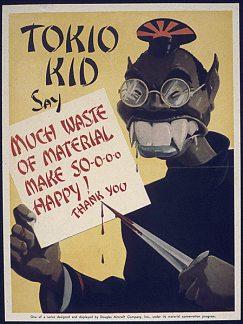
However, both before and after WWII, Japan and Japanese culture has had a positive, or at least fetishized and exotic image in the West. This is partly down to attitudes to Japanese female sexuality, which is eroticised by Western media (just watch literally any film where a ‘white guy’ goes to Japan from ‘You Only Live Twice‘ onwards) but also because Japanese movies, video games, manga, Samurai or Bushido culture, Kanji, Ninjas and art are considered ‘cool’ by many in the West. Few in the West who fetishise these aspects of Japanese culture (much like those who think Chinese culture is about Kung-Fu and nice looking handwriting) have ever had any direct experience of Japan or Japanese people. Their main point of contact with ‘Japan’ is the Japanese cultural output (broadly speaking, ‘art’) and the Western media representation and appropriation of this (not always positive but nowhere near as negative as in the case of the Middle East and Islam). Although Japan and the West don’t quite have the antagonistic history of Europe and Islam or Europe and Judaism, there are the recent Japan – Russian, Sino – Japanese Wars (which was a threat to the colonial powers in China) and Second World War, so the parallel is not too dissimilar. However, unlike Japan, Islam does not really have what Amy Chua has called (in reference to the United States) ‘an overseas fan club’[13]. By this she means that the US can get away with a lot more morally questionable behaviour than say Iran or Russia and still maintain a glamorous and positive image in the minds of many because it has a lot of people overseas who aspire to American culture and its symbols – in short, are its ‘fans’. Lots of people, especially young people born after the vicissitudes of colonialism, aspire to be Americans or French or English. Some in the West even aspire to be Japanese. Hardly anyone anywhere outside the Islamic world (and quite a few within) aspire to be Muslim or appropriate their cultural symbols or language.
I would posit that a big part of this is that unlike the Chinese or Japanese culture, Islam has been furnished by its followers (of late) with very few points of interaction with others. This makes them appear alien and inscrutable and thus easy to misrepresent. For example, young people in the US and Europe interact with Japan and grow up admiring it because of its animations, cinema, comics (found in literally all major bookshops from Scotland to Spain – in the local languages), calligraphy, dress and other ‘cool stuff’. Islamic art has none of these ‘points of contact’ because it is largely decadent and assumes a religious component. There are even lots of ‘J-Pop’fans in the West, but again, this is made impossible for Muslims by their own leaders. The Japanese pop culture phenomena has recently been repeated in the case of South Korea, with a huge interest in this nation’s movies and music amongst Caucasian Westerners and the Koreans have done a remarkable job marketing themselves off the back of this with music and film festivals as well as cultural events. Of course, if Muslims were ever to have a foreign government sponsor a cultural event, we know who would be paying: there would be no music and the centrepiece would probably be the beheading of a Philippine domestic worker.
What any of this has to do with apostasy is that young Muslims feel alienated in that they are always appropriating and admiring the cultural symbols of others, to whom they can never belong as a community, and lacking any of their own. They listen to Japanese music, have a poster of Brad Pitt on their bedroom wall, watch American movies and consume French art. But Japanese people can listen to their own music, Americans can watch their own movies and so on. The decadence of Islamic cultural output, from the virtual absence of the novel in Arabic to the banal racket that passes for ‘Islamic’ music denies Muslims this opportunity. The reason that Islamic arts are decadent is partially colonialism but mainly puritanism – you aren’t going to excel at sculpture or drawing comic books if you think they are going to cause you to burn in hell. Islamic art had its heyday, in fields such as architecture and calligraphy and it has its apologists (such as Sayyed Hossein Nasr in his excellent ‘Islam and the World’ and other works) but it is utter self-delusion to believe that that was anything but another life.
Further, Muslim excuse making does not help: Calligraphy is not the only halal (permissible or licit) form of Islamic painting – where are the Islamic landscape painters? The Ottoman or Muslim Turner or Monet? No doubt some will try to point to Mughal miniature painting or the anthropomorphic representations allowed by some Shia artists as counter-examples but if such works are compared with the contemporaneous efforts of Dutch or French artists, the results are decimating to the ego of Muslims (not that Muslims could furnish a single art historian to argue their case anyway, since studying art history would be considered useless by virtually all ‘practising’ Muslims in the West)
Outsiders do not in the first case interact with other cultures primarily via their religious text or ‘Dawah’ but rather through their art. That is how nearly everyone outside America first interacted with that culture. But what is called Muslim ‘art’ today and for a long time in the past is absolutely pathetic. Of course, people will be loath to believe this (and will be eager to point out minority cases such as Chinese Muslims} but it’s one of those things that one can’t prove…and yet everyone somehow knows is true.
The decadence of Islamic cultural expression and art has a dual purpose in apostasy: on the one hand it makes it very easy for opposing interests to make Islamic culture look ‘unfashionable’ (and fashion is a driving force in human relations. This is of course lamentable but it must be accepted and adjusted for) and thus dissuade many people from taking an interest in it (unlike how people graduate from watching Japanese animations to learning more about Japan or at least having a positive impression of the culture). Concurrently, it makes Muslims feel culturally vacuous and inferior, which sadly is largely true. But such feelings are often generalised to the religion of Islam too, which is surprisingly easy as Muslim authorities tend to use religion as the justification for practically everything, especially their recent artistic cultural and academic underachievement (‘well, we suck at music and painting because it’s haraam, a waste of time blah blah’).
Muslims are often, very rightly, fond of pointing out that apostates are ‘Uncle Toms’ who subserviently and uncritically adopt the dominant cultural values of the West. This is true. But Muslims rarely go on to ask why such people felt the need to do that – you know, if ‘Islamic culture’ was so great compared to the others that is. In movies, games, comics, clothes, art and fashion, we are all ‘Uncle Toms’ and cultural apostates but we can’t be blamed. Muslim music, clothing, art and other cultural artefacts are just not any good. And they haven’t been for a long time.
Life, Liberty and the Pursuit of Happiness: Muslims Must Stop Restricting Peoples Career Choices and Hobbies
Closely allied to the above – if you are a Muslim Mozart or Rodin (before people start pointing it out, yes I know some of the sculptures are nude, the fact that I had to mention that is illustrative of our mentality), you are finished before you have picked up a pen or a scalpel. This seems to most Muslims to be a minor thing but, say, to a potential Mozart, it’s a very big thing – not being allowed to do the thing you love, especially if the thing you love is not something obviously bad or evil like music or sculpture, can create a serious conflict in the minds of people. Most ‘practising’ Muslims seem to approach these kinds of problems in their brethren as a test of faith or as a chance to tell them to ‘man up’ and put their religion before their hobbies. But this ignores the fact that some people feel almost as strongly about other things as some do about their faith: when it is said of someone that ‘golf is his religion’, it is meant that golf is the thing to which all other things take second place. Whether this is a good or bad thig is another issue, but nonetheless, it is a reality for many people and despite their seeming denials, Muslims are just people: God only created one ‘operating system’ for humans, no matter how much Muslim scholars dislike it
For God’s Sake, Stop Bringing Religion into Everything
In a way today, Muslims, especially the practising ones, have become a kind of mirror image and reaction to secularists: whereas the latter insist religion should be kept out of ‘public’ life (by which they actually mean everything), Muslims instead try and inject religion into literally everything. In fact they are even proud of doing so and boast of how intrusive their religion is and that it prescribes everything for them and because of that they will find what I have said offensive. This is because of a number of reasons. A number of universal and noble moral and political guidelines in the Quran were exaggerated into a comprehensive political manifesto by certain sects. The A’shari theologians relegated the role of man in moral knowledge to total irrelevance and denied free will, creating the problems of God’s compulsion of man (jabr). The uninhibited indulgence in hadith by the Muhaditheen caused some of them to demand a narration for literally everything (Ahmad Ibn Hanbal upon not finding a narration for eating melons refused to eat them, with other jurists echoing this principle and saying that all things not ‘mentioned’ automatically had the designation of ‘forbidden’. The fact that this story of Imam Ahmad is proudly remembered by Muslims of a puritanical bent is illustrative). Those beholden to narrations, of often dubious authenticity by the standards of everyone other than the traditionists themselves will of course be more partial to arguing that a narration exists for every aspect of life (although this is patently false as we can see from the obvious fact that the very pertinent knowledge of Prophetic medicine is nearly entirely lost – which is why Muslims only ever talk about ‘Black Seed’ being a cure for everything, a position which Muslims, like Evangelicals and their alleged ability to drink poison unaffected, do not actually believe in).
Those (very few) Muslims who take the Quranic emphasis on intellection and investigation seriously will be less so inclined, but nonetheless, a devastating corollary of Muslims emphasis on the intrusiveness and all-encompassing nature of their faith (which in practice is not in terms of their moral or ethical lives but rather limited to hadith-spamming) is that whenever Muslims do something good (like win an award), they thank, credit and praise God. And when they do something really stupid, like blow up a train carriage full of kids, they likewise thank, praise and credit God. I’ve often said that Islamophobes just re-label crimes done by Muslims to make them religious in nature – so a crime of passion where a man kills his wife is apt to be just that if the man is a Caucasian but to be an honour killing if he is of a darker hue, but in reality, Muslims are largely guilty of this too, crediting God and religion for terrorist and interpersonal attacks or beating their wife as opposed to their own base motives. Christians, while committing far more and worse crimes in the West as is expected by their preponderance, are hardly ever seen to use the ‘Jesus made me do it’ excuse.
Newly practising Muslims of the Salafist orientations remind me of puppets: you have to pull on a hadith otherwise it is impossible to get them to do anything, so assured are they of the need to find a narration to govern every aspect of their lives. This actually has the effect of atrophying their moral and intellectual faculties. Muslims are rightly proud of the well attested narrations (backed up by the practice of the Companions of the Prophet and opinions of the jurists) that empower them in good hygiene and manners, but they have mistaken the gentle guidance of the Prophet (and the authenticity of what remains of it) as a prescription that extends to what colour trousers to wear.
I was surprised to find the truth of Ibn Khalduns’ statement that the hadith literature is, as a rule, contradictory and requires expert appraisal and application when I undertook Hadith studies. When studying the issue of how to perform ablutions and timings of prayers from hadith alone, I was alarmed to discover that the hadith actually added to the variety of opinions and confusion, until clarified by my Maliki and Hanafi teachers using the amal (practice) of Madinan jurists and applications of the companions (in the Hanafite) case. Even this was a heuristic solution however. Not for nothing is it said that ‘hadith without fiqh [legal theory] is misguidance’[14].
So far as I am concerned, the belief that you can shut off your moral and intellectual sense because there is a narration to tell you how to do everything is observably untrue (sahih narrations do not even clarify how to pray a single cycle of the compulsory prayer let alone ‘everything’ such as how to cure cancer. Even Salafists know this idea is false, so to this they have added the comments of the ‘rightly guided’ Salaf, forgetting that most of the heresies in Islam including Sh’ism and others are directly traceable to the same ‘Salaf’ and opinions of scholars, thus introducing a truly vast and insurmountable corpus of varying but usually poor quality and attestation).
It might be going too far to say that Muslims do not take an interest in scientific issues as well as moral ones because they think that all of the answers are ‘already in Islam’, but the impression they gain from their religious leaders is certainly along those lines.
Sadly, I fear Muslims have gone too far along the lines of ‘naql not aql’- which is a formula Muslims bizarrely utter with pride that means Islam is a religion of imitation as opposed to intellect (despite God saying the opposite in the Quran – but what does He know!) to be lead back from this precipice without the loss of many lemmings. But at the very least, the Muslim propensity for ‘Islamicising’ the stupid and violent stuff they do based on revenge, nationalism, political motivations and just downright psychosis and stupidity tends to have the same effect as the Islamophobes assertions that the bad things Muslims do are due to their faith – putting religious window shoppers off and making Muslims, especially the thinking ones, ashamed of their community and faith, which is a necessary pre-requisite of apostasy.
Bringing religion into everything that you do has become a psychological identifier of ‘practising’ Muslims but it is in fact a handicap – far from being an antidote to secularism they have gone to the other extreme and brought Islam and religion into disrepute by reflexly involving religion in all the good and bad they do.
The Ability to Approach a Member of The Opposite Sex without Scrutiny, and Yes, DATE them if Needs Be (Yes, I said ‘DATE’): Muslims Must Stop Restricting People’s Ability to Find a Partner and Have Sex
Any system which brazenly opposes human biology, specifically those aspects pertaining to personal and species survival is doomed to failure. Muslims pay lip service to this by claiming that there is no monasticism in Islam but the reality is far removed. A generation of unwilling and unhappy virgins is found amongst practising Muslims and their desperation is such that fifteen year old schoolgirls are willing to leave England to go into a war zone…just to ‘get laid’[15]
The fact that all practising Muslims are more than familiar with is that ‘Islam’ is making it practically impossible to get a partner of any kind of quality. This makes life miserable and Muslims are constantly distracted by their unfulfilled or poorly satiated urges. Most young Muslims spend their time looking in at the rest of society like a penniless kid looking at a toyshop window. At Christmas.
The recent Ashley Madison adultery website hack, apart from demonstrating that IERA Salafi segregation masters also allegedly like a bit on the side[16], showed something else shocking: out of 33 million profiles, less than five million were women. And even many of those were fake[17]. You can bet that most of the ‘halal’ marriage sites are exactly the same (or try to attract women by making their memberships free unlike for men – about as fair as ‘ladies nights’ at nightclubs): that’s because you might have noticed that when attractive women want to cheat or find a partner, they can usually find a taker and thus don’t need to resort to these means. Muslims are living in a magical dream world where attractive men and women are in the ‘arranged marriage’ system or go to their local Imam to find a partner. As every American housewife knew from ‘I Love Genie’ onwards, the good ones are already taken.
Tragically, the magical thinking around the mating game disproportionately affects practising Muslims, who believe that God will find them a partner (though he made no such assurance, any more than he promised to find you a job or pass your driving test for you) and overlook the patently unrealistic formulas advocated to Muslims when it comes to finding a mate. I told a desperate not-so young man in mosque that he should start dating, while assiduously avoiding fornication, or likely with his lack of religious and family connections, he would be perennially single. I was almost lynched.
Quite apart from the fact that most ‘practising’ Muslims advocate that all of the means that could in any likelihood lead to meeting a guy/girl, from looking at them to being in the same room, are in fact haram or makhruh, (essentially ’illegal’ and ‘immoral’) even those willing to allow that much (a minority) started putting on their white hoods when I mentioned ‘dating’ because of course, dating means sex. Like it is impossible to just get to know someone and go out together, because you must have sex. We as a community have bought in to the dichotomy of the monoculture: there is only promiscuity or abstinence and if you see a member of the opposite sex and go out with them then the aim is to get them into bed as soon as possible as opposed to just getting to know them. But in the West, the only reliable way to get a partner is to approach someone you like, get to know them by spending time with them (yes, unsupervised, but not alone, for example, at the theatre or an art gallery) and then see if you want to get married. And this is not a decision that can be made in a single meeting or twelve or any fixed time – it depends how quickly and well you get to know each other. Some randy people will end up having sex in this process the same way that many unmarried people will start to masturbate compulsively, consume porn and become sexually deviant. Both have their dangers, not only the first scenario as scholars would have us believe.
The idea of curtailing all male female interaction because it may lead to fornication would be consistent if Muslims applied the same paranoia about sin to all aspects of morality (Muslims are noticeably less inclined to continuously audit people’s wealth to avoid non – payment of tithes or zakat as they are to monitor male female interactions to avoid ‘sin’, or to warn their children about reading Salafi literature because it may lead to killing people). This is about as stupid as banning books because some of them are ‘dangerous’ (the Saudis for example have ‘banned’ the Bible).
In any case, the idea that transgressions of a sexual nature are the worst things that can possibly happen to a person has become too ingrained in Muslims minds to address – the proof of this is that nearly all Muslims (wrongly) consider it to be valid that the punishment for adultery should be worse than for murdering a child.
Puritans of every bent and religion consider endurance of misery to be a sign of strong faith. In this they are mistaken, as the wave of Muslim apostasy will no doubt show once again. Labelling all pleasant sensations as ‘hedonism’ is banal and inaccurate but it is hard to deny that practically all Muslim groupings extant in the West are of such a puritanical bent. You have to already have a good knowledge of Islam to put up with this let alone try to fix it. Most others, quite wisely will see that this religion is making their life hard and restricting their choice of partner and not even providing them access to that restricted grouping either. They will make what is biologically the smart choice: look outside the community, with or without apostasy (usually with).
NOTES:
[1] ‘Islam and the New Central Asia‘ by Oliver Roy, the chapter on ‘The Sovietisation of Central Asia’ provides an excellent overview.
[2] Hammad ibn Salama reported from Qatada, from ‘Ikrima, from Ibn ‘Abbas, that the Prophet said, “I saw my Lord in the form of a young man, beardless (amrad) with short curly hair Ua’d) and clothed in a green garment.”
Ibn Hanbal made its belief obligatory: in his ‘Aqida III‘, ‘And that the Prophet saw his Lord, since this has been transmitted from the Messenger of Allah and is correct and authentic. It has been reported by Qatada from ‘Ikrima from Ibn ‘Abbas‘.
‘Aqida V’: ‘In one of the sound hadiths about the Messenger of God, it is said; ‘The Prophet has seen his Lord.’ This is transmitted from the Messenger of God. Qatada reported it from ‘Ikrima from Ibn ‘Abbas…. Belief in that and counting it true is obligatory‘.
This hadith is reported twice in Ibn Hanbal’s ‘Musnad‘, and ‘Abd Allah narrates it repeatedly from Ibn Hanbal in his ‘Kitab al-Sunna‘
Ibn Hanbal also reported in his ‘Musnad’:
”One morning, the Messenger of God went out to them [his companions] in a joyous mood and[with] a radiant face. We said [to him]: “Oh Messenger of God, here you are in a joyous mood, with a glowing face'” “How could I not beT’ he answered. “My Lord came to me last night under the most beautiful form (ft:a~san ~ara), and He said [to me]: ‘Oh Muhammad!’-‘Here I am, Lord, at Your order!’ He said [to me]: ‘Over what disputes the Sublime Council?, – ‘do not know, Lord.’ He posed [to me] two or three times the same question. Then He put His palm between my shoulder blades, to the point where r felt its coolness between my nipples, and from that moment appeared to me [all] that is in the heavens and on the earth.
[3] “…When half o a third of the night passes by, Allah descends to the lowest heaven and says: ‘No one asks more about my servants thatn myself. Who is asking me, so I can give to him? Who is calling uon me, so I can answer him? who is seeking my forgiveness, so I can forgive him?'”
In case you think I am caricaturing Salafis, here they are asserting the ‘reality’ and ‘literalness’ of this descent from no less of a Wahhabiu authority than Uthaymeen:https://islamqa.info/en/20081
[4] For example, many of the groups in Islamic history which were anathematised by Sunnis, including the Mutazzila or Kharijites as well as most Shia and even many early Hanafis, were much more impermissive and catholic in their choice of hadith. By Salafi standards today, they would be considered ‘hadith rejecters’ – not in the sense that they rejected all hadith but rather employed a great deal of scepticism before attributing things to the Prophet Muhammad. Hence defending the hugely more permissive attitude of Hanbalism and the Shafis towards narrations, including allowing hadiths to abrogate, specify and replace the Quran or the practice of the Sahabah or the jurists of Medina, became a badge of honour for these groups against their perceived enemies. In the colonial period, many scholars, including many well-known and sympathetic ones such as Goldziher through Watt to Juynboll cast significant doubt on the hadith literature. The ideological component of the response from most Muslims was a doubling down of efforts to defend the entire canon but most importantly the redaction of Bukhari. They have now found themselves held to this and are in the astonishingly difficult position of defending all of the hadith contained in Bukhari, and many more besides – a task which had previously proved impossible even against Sunni interlocutors such as Darulqutni and of course the Mu’tazzilite theologians.
[5] For example, fathom even the famous jurist Qadi Iyad’s explanation for the hadith of Moses refusing to submit to God’s command when the Angel of Death was sent to him at the end of his life: there is simply no connection between his explanation and the text of the narration. The same can be seen with numerous other cases such as the editing out the word ‘anus’ in the text of Bukhari and the utterly scandalous ‘explanation’ for the hadith of the sun bowing to the arsh (throne) found in modern ‘tafseers’ such as ‘Maraful Quran’ by the Deobandi sect.
[6] For Al Qaradawi’s apologetics on Bukhari’s narrations about the killing of non-Muslims, see here:http://www.onislam.net/english/ask-the-scholar/crimes-and-penalties/retaliation-qisas/175024-killing-a-muslim-for-a-non-muslim.html
[7]http://www.independent.co.uk/news/world/middle-east/isis-throw-man-off-a-building-for-homosexual-affair-and-beat-him-to-death-when-he-survives-10012709.html
[8]https://asharisassemble.com/2015/07/05/many-muslim-leaders-denounce-isis-out-of-convenience-not-conviction/#_edn53
[9] 2:30 ”AND LO! Thy Sustainer said unto the angels: “Behold, I am about to establish upon earth one who shall inherit it.” They said: “Wilt Thou place on it such as will spread corruption thereon and shed blood – whereas it is we who extol Thy limitless glory, and praise Thee, and hallow Thy name?” [God] answered: “Verily, I know that which you do not know.”
Muslims, shamelessly, love to stop quoting at this point, to give the semblance of God using argument from authority. If anyone could, then it is He, but he doesn’t, and instead provides a QED:
2:31 ”And He imparted unto Adam the names of all things; then He brought them within the ken of the angels and said: “Declare unto Me the names of these [things], if what you say is true.”They replied: “Limitless art Thou in Thy glory! No knowledge have we save that which Thou hast imparted unto us. Verily, Thou alone art all-knowing, truly wise.”
Said He: “O Adam, convey unto them the names of these [things].”
And as soon as [Adam] had conveyed unto them their names, [God] said: “Did I not say unto you, ‘Verily, I alone know the hidden reality of the heavens and the earth, and know all that you bring into the open and all that you would conceal’?”
This constitutes nothing other than an empirical demonstration and response to the Angels question, followed by ‘I told you so’.
So God can be questioned but not the scholars it seems. Maybe we should worship them then?
[10] https://primaquran.wordpress.com/2016/02/11/are-arabs-superior-to-malays-and-everyone-else-imam-shafii-and-ibn-taymiyyah-think-so/
https://asharisassemble.com/2013/04/17/superiority-of-arabs-in-islam/
[11] https://shaykhatabekshukurov.com/2014/03/04/the-truth-about-islam-and-female-circumcisionfgm/
[12] http://www.telegraph.co.uk/news/worldnews/africaandindianocean/somalia/11611954/White-Widow-has-killed-400-people-as-key-figure-in-al-Shabaab.html
[13] Amy Chua, ‘World On Fire: How Exporting Free Market Democracy Breeds Ethinic Hatred and Global Instability ‘, page 200 onwards.
[14] Ibn Abî Zayd al-Mâlikî reports Sufyân ibn `Uyayna as saying: “Hadîth is a pitfall (madilla) except for the fuqahâ’,” and Mâlik’s companion `Abd Allâh ibn Wahb said: “Hadîth is a pitfall except for the Ulema. Every memorizer of hadîth that does not have an Imâm in fiqh is misguided (dâll), and if Allâh had not rescued us with Mâlik and al-Layth [ibn Sa`d], we would have been misguided.”
Ibn Abî Hâtim in the introduction of al-Jarh. wa al-Ta`dîl (p. 22-23); Ibn Abî Zayd, al-Jâmi` fî al-Sunan (p. 118-119)
[15] http://www.independent.co.uk/news/world/middle-east/isis-jihadi-brides-women-british-syria-kadiza-sultana-radicalise-terror-trapped-abuse-married-air-a7187946.html
And infinite other stories about girls going into war zones lured by catalogues of ‘Jihadi husbands’. In all honesty, you will not see even the most slut shamed girls in the West from non-Muslim cultures going to war zone to get sex.
[16] IERA’s Hamza Tzortzis was implicated in the adultery site ‘Ashley Madison’ hack – hilariously, he is trying to bury the story using new ‘right to be forgotten’ legislation, as Google informs you when you search for his name and Ashley Madison:
”The recent ruling by the Court of Justice of the European Union has profound consequences for search engines in Europe. The court found that certain users have the right to ask search engines like Google to remove results for queries that include the person’s name. To qualify, the results shown would need to be inadequate, irrelevant, no longer relevant, or excessive.
Since this ruling was published on 13 May 2014, we’ve been working around the clock to comply. This is a complicated process because we need to assess each individual request and balance the rights of the individual to control his or her personal data with the public’s right to know and distribute information.”
Nice to see that the ‘kufaar‘ system has some useful laws for Salafis after all!
Here is one of the few news stories you can still find about him and this affair, which he denies. But wants forgotten. Go figure.
[17] https://theintercept.com/2015/08/20/puritanical-glee-ashley-madison-hack/
 Asharis: Assemble
Reblogged this on Blogging Theology and commented:
A fascinating intellectual tour de force, though with much to disagree with..
This article is like a summation of everything on this site. I think this may become your viral post like ‘blackmailed by Bukhari’
Wonderful writeup.
A bit late for me but I hope it helps other muslims who are going through the predicament of “making sense” of their religion. At some stage I also went through the phase of “Let’s ignore all BAD ahadiths as untrue and only take that makes sense”. The obvious problem that followed was ” How can I be proud of Prophet Muhammad (PBUH) based on a hadth on Page 32 but ignore the so-called bad hadith about him on Page 33″.. This sounded hypocritical to me.
Another associated problem was that if I find certains ahadiths immoral then why is that muslim scholarship of 1400 years has not openly banished it? Why is it even in the books in the first place. Why is it that instead of challenging the idea of Prophet’s nikah with a 6-year old, my local imam (in Germany) talks about the “fiqhi issues” related to doing nikah of toddlers and kids. That session just spun my head. It was Ramadan btw
We love talking about “decadent west” and amoral secularists but if we are honest we will find some of the most disgusting morals practiced (or at least believed) among us. This just destroyed the argument of “Why we need religion to guide our morals”
The lack of role models is really hurting and so is the idea of shoving religion in everything. I hope more people wake up to its perils
Unfortunately, I couldn’t stay Quran-focused muslim for long. Books like “My Ordeal wih Quran” created significant doubts for me in Quran as well. I wonder if that book has been reviewed on this site
Thanks
Thanks a lot!
I haven’t read the book actually. What is the biggest problem in the Quran as far you are concerned?
Bismillah,
As salamu ‘alikum warahmutallahi wabaraktuh respected brother. I have downloaded the book at the link. Thank you! I have allot lined up as I plan to start blogging/writing again at Prima-Qur’an. Insh’Allah, I hope I get a chance to look over and respond to some of its contents.
Are you aware of any Muslim academic/scholars who have engaged with it?
Too late here to describe. But the thing that affected me was how some ayahs are just disjointed and confusingly created or lack rythm and don’t really go in together.
You can find it here http://ex-muslim.org.uk/wp-content/uploads/2016/02/My-Ordeal-with-the-Quran-Complete-Full-Version.pdf
If you find this book worthy of responding to I will be very keen.
Thanks
As usual, I’ll comment only on peripheric parts of the article, that mention Christianity.
What I noticed most was the passage about “Unitarian Newton”.
One thing I’ll probably never understand about today’s Muslims is how they instinctively view Unitarians as “nearer to Islam”
than other Christians. Because as far as I’m concerned, the complete opposite is obviously true.
Muslims think too fast, perceive a few words in a sentence and jump to conclusions. For example, as soon as they see or hear “God is one” in a sentence they automatically assume that it’s tawheed. Few pause to realize that if you add “of three”, it is shirk according to the Qur’an.
This is exactly the case with Unitarians. Their “monotheism” is that God is only one “person”, i.e. that it is the Father, not the Son or the Holy Spirit. Tell me, which Christian group is saying that “God is one of three” here ?
While most other Christian groups say/believe that Jesus is God and worship him as such, Socinian Unitarians deny the divinity of Jesus yet worship him all the same. Tell me, who is “worshipping another beside God” here ?
The Arian form of Unitarianism (which is the one Isaac Newton seems to have adhered to) suffers from similar criticisms. Also, their belief in an “intermediary”, semi-God pre-existent Jesus with a status between divinity and humanity conflicts with the quranic (and Christian) view of Jesus as “son of Mary”, who “ate food” (Jesus himself emphasizes this point in the Gospels, and after his resurrection invites his disciples to see and touch his body for themselves).
You are welcome to comment on ANY aspect of the article – your comments are always valuable and informative!
To be honest, my aim in the discussion of Christianity in this article, including the Trinity, was to try and moderate some of the smugness that Salafis and other Muslims show in their relations with Christians but I can see that it probably came across as a bit smug and entitled itself.
I was trying to say that Muslims need to be humble in the face of great thinkers such as Newton – and as you imply, we don’t really know all of what he believed – he was heavily influenced by hermeticism etc and his extremely voluminous writings on the Bible and theology are yet to be critically published, so certainly his theological credentials are major.
I agree with you that Muslims reflexively ‘like’ Unitarians, although I believe today’s Unitarians are pretty nuts.
When you say that “today’s Unitarians are nuts”, I suspect that you mean “Unitarian Universalists”. They aren’t the only kind, however. Just the most prominent one.
And the “reflexive liking” of Unitarians is, for the most part, well-founded. Indeed, the modern rebirth of Unitarianism was made possible by the protection and encouragement of the Ottomans, who sheltered many Unitarians from Italy and Eastern Europe after they had fled prosecution at the hands of the Catholics and fellow Protestants.
Catholic Commentator mischaracterizes Unitarianism by presenting it as much more monolithic than it is on the issue of its attitudes toward the elements of the Trinity. But, judging by his or her name, he or she kinda has to. 😉
If nothing else, an English Unitarian authored the first European defense of Islam and Muhammad, which fact alone should go a long way toward mutual amity.
(Also, I’m completely comfortable saying that even an Arian Newton (if, indeed, he was one) is still a better Muslim than any of the typical Internet Salafis…)
Hows it going Catholic Commentator. I had a few questions about Christianity that I’ve been wondering about for a while, What is the difference between Catholics and Orthodox Christians? Are they on an agree to disagree basis, or do they consider the other illegitimate? I didn’t read any great conflicts between the two sects other than the beginning where there was a conflict about iconography of some sort which caused the schism.
What are your thoughts on the current state of protestant Christianity?
Would you say that the works of Saint Augustine and Saint Thomas Aquinas are all one needs to understand Catholic Christianity? What other books would you recommend?
How are Catholics doing in an age of rampant Secularism, how did they survive a massive wave of anti Catholic sentiment over the years?
What advice would you give Muslims living in secular anti religious societies, how did Catholics protect their faith?
I think a case in point in favor of your item about the decadence of Islamic cultural expression is food. If Islamic music, art, and science fiction were as appealing to Western teenagers as kebabs are to English piss-heads (for just one example), you could cross that big point right off your list.
Well, to be honest, even Doner Kebabs, the only type that are actually an invention as opposed to just standard grilled meat, were invented by Greeks.
Salam Ammar,
Thank you for your comment.
Please check out http://en.alukah.net/World_Muslims/0/4842/
I found that article and more so the book enlightening about how the Qur’an is marvelously composed from the verse to the entire text.
Regarding rhythm, please see the work by Sells on the Qur’an and the book by Neal Robinson on Discovering the Qur’an.
Salam Ammar,
Thank you for your compassionate comment.
Please check out http://en.alukah.net/World_Muslims/0/4842/
This article and more so the book helps illustrate how the Qur’an is marvelously composed at all levels whether from the verse to sections of verses to surahs and to the entire text.
Regarding rhythm, please check out the book by Sells on the Qur’an
https://www.amazon.com/Approaching-Quran-Revelations-MIchael-Sells/dp/1883991692
and the book by Neal Robinson entitled Discovering the Qur’an
https://www.amazon.com/Discovering-Quran-Contemporary-Approach-Veiled/dp/1589010248
These books and others demonstrate the immense rhythm in the Qur’an.
I wish the best for you.
Finally the Islam of the creator making a comeback…the Islam that gels with our God given common sense and intellect
Thanks @Brother in Islam”
I will check it out. To be frank I don’t believe that Quran as-a-whole has problems. There are indeed beautiful parts both from the rhythm (poetic) and content-wise. I will continue to use them as guide. BTW, the book I referred to also doesn’t make a blanket claim about Quran.
Salam
Sounds good Ammar.
Also, please don’t think it is too late for you.
It is not. The important thing is for us is to always keep a good conscience, pray regularly to God (the cause of all existence) for guidance and to be good to others. Inshallah, God will then guide us.
Also, I see what you are saying about the difficulty you had in the approach of accepting some hadith but rejecting some as well.
You need not feel that it is cherry picking to do so. The Prophet would be the most ardent follower of the Qur’an not only in the letter but also in the spirit of it.
Far more than us, the Prophet would not accept any hadith that conflicts with the spirit of the Qur’an for he was the recipient of the Qur’an directly from the Angel Gabriel.
Anyhow, I would not recommend people to read hadith unless they are grounded deeply to the Qur’an and they realize how the hadith transmission does not fulfill the Quranic requirements for authenticity of claims (Surah 2, verse 282) which requires 2 witnesses and for any claim to be written down immediately (not decades or a century later).
95% of the hadith have only 1 witness (at least the first level of transmission)
Take care.
May Allah bless us all. Ameen.
This article made my day. It needs to go viral
@mmmclmru
“But neither this nor the organisation, financial clout and centralisation of the Catholic Church was of any use against the arguments/propaganda/tele-evangelising of the Liberal contingent.”
The situation is actually worse in the Catholic Church than what you describe. Since Vatican II, all the “organisation and centralisation” of the Catholic Church has been taken over by traitors and professional saboteurs.
Those people are very skilled, they never to state their goal clearly, they always alternate steps forwards and backwards. For a recent example, see how “Pope” Francis applies this to gay marriage at http://qz.com/516655/confused-about-the-popes-thoughts-on-gay-rights-no-wonder/.
Salafi propagandists look amateurish in comparison. Even Muslim saboteurs have to learn from non-Muslim saboteurs how to practice their sabotaging.
I think that because of the decentralized nature of Islam, it is easier for a Muslim today to free himself or herself mentally from the Salafi takeover of Islam than a Catholic today to free himself or herself from today’s traitorous Catholic leaders, who will blackmail their people with “obedience”.
Bismillah ir rahman ir raheem, Allahumma Salli Ala Muhammed.
Wow. What @mmmclmru wrote may to some look like a ‘rant’ do not realize that this is an accumulation of months, and years of researching and most importantly living these realities. To string together all of these blocks of information into paragraphs that flow so well and so filled with raw emotion is something that needed to be said. No doubt if this article was published and circulated to a wider audience there would be so many who find resonance with what is said.
I think that though the author primarily focused on the Dawatus-Salafiyyah movement; the rest of the article has clearly laid before us a crisis in being consistent in methodology among Sunni Muslims in general. Everything from inconsistent standards in Christian-Muslim dialogue and polemic. Inconsistent standards on science being the ‘end all be all’ let us not forget that Harun Yahya (may we be benefited by what is good from him) is not from the Salafi movement; and yet the ‘cut & run’ approach when it comes to the ahadith.
To the fact that many ‘traditionalist’ will disavow ISIS, right Salafis are the bad guys and us Sufis are the good guys, even though ISIS are basing their positions on the same traditional text that are upheld by the ‘good cops’ use. In fact when one reads between the lines its frightening and revealing that the ‘good cops’ are not even saying these things are wrong when you look closer. They are saying they are doing this without a recognized and proper Khalif. They are doing this without authority from a recognized qadi. So in reality this is a matter of separating the wheat from the chaff. Almost every act that Non-Muslims and even many Muslims find barbaric and distasteful enacted by ISIS is found in the “traditional” Islam.
In fact when Sheikh Muhammed Al Yaqoubi (may we be benefited by what is good from him) wrote his Radd against ISIS was not one of the three main points is that what ISIS does damages Islam! We have yet to really discuss what does that actually mean. Maybe someone here would tackle that. That what ISIS does “damages Islam”. What is Islam being defined as here? How in what ways does it damage Islam?
So when people at Avicenna Academy and Asharis Assemble say it is time to look at some of this ahadith literature they can get accused of not simply by Salafi Muslims but by “traditionalist” as being appeasers of the West. So we would have to ask on what consistent basis is the respected and blessed Sheikh Muhammed Al Yaqoubi (may we be benefited by what is good from him) lauded for saying that the application of text by ISIS ‘damages Islam’ ; where as Avicenna Academy, Ashari Assemble and others may even have a stronger refutation in saying, maybe its not even about the application, maybe its the text itself!
“The Sanctification of the Scholars Must Stop!” Beautiful. I do not understand how is not possible for us to still respect Ibn Hajar Al Asqalani (raheemullah) and the great luminaries of the Islamic tradition and give full respect and adaab to them and also not be able to critique their positions on certain matters. In fact, look today. A plane can take you to a museum where the curator allows you to look at ancient manuscripts all the while you enjoy a briquette and hot coffee at the local hotel. You have knowledge at the tips of your fingers via academic peer reviewed research journals online; and how many Muslims today have published volumes upon volumes?
In fact the irony is that the Salafi Manhaj in its usul-al-fiqh approach is fundamentally sound in wanting to take the stronger and best opinions. That is something they bring to the table that is often overlooked. Unfortunately, what could have lead to a revolution in fiqh where we follow a school of jurisprudence and take a ruksa or opinion that is best suited to our situation, has become a brand new monolithic madhab where we follow the fiqh of Bin Baaz, Uthaymeen and Al Abani (may we be benefited by what is good from them).
“You are a layman, follow the scholar.” This sounds logical but it is such an illogical statement to make. Why? Because if your a layman or simpleton how would you know/assess who is/who is not a scholar?
In fact here in Singapore where we play ‘good cop/bad cop’ there is always clamor of ‘look to where you take your deen’, ‘be-careful where you get your religion from’, ‘don’t take your Islam from Sheikh Google’.
On what consistent basis can a layman or pismire such as myself not be allowed to assess what a scholar says but apparently am confident enough to assess that said person is a scholar to begin with and/or the correct one.
Lastly, it is my hope that this last paragraph gives us hope that this is just the beginning. That mmmclmru has more to come, Allah-willing
“My aim here is simply to provide a roadmap, in its general outlines, of the methodologies, ideas, fatwas and leeway – the ‘tools’ if you will, that ordinary Muslims in the West or anywhere else for that matter, will require in the coming decades to hold on to their faith. It is my subjective perception of the problems they are already facing and will increasingly face and how best to circumvent them. It is not a detailed verse by verse apologia but rather a description of those attitudes of mind which if held may enable one to avoid the worst travails without necessarily having in depth knowledge of specifics. For example, unlike the majority of rather ineffective yet confusingly long and convoluted ‘explanations’, I won’t be trying to explain individual problematic hadiths or juristic decisions. Rather I will be trying to encourage an attitude or epistemology towards these that can enable one to avoid doubts in principle.”
Is this not the need of the time?
Pingback: Response to Apostasy Survival Kit | primaquran
Damn, can someone toss me a list of all the great Maturidi and Hanafi classics? Usul e fiqh, mukhtasar, fatawa, usul e hadith etc etc. Help this poor layman out pls! I just want to compile a great ‘get round to study’ list. I’ve always thought that Han Kitabu writings, Ming/Qing era scholars such as Liu Chi or Wang Daiyu, always had the best potential in exposing people, even Muslims, to Islam. Since they begin with cosmology, pointing out how Islam resonates with many Taoist and Neoconfucian views (which are seen pretty positively in the west these days), rather than civilisational posturing, fetishising over the adjective ‘islamic’ and dry talks on hadith and fiqh, which these days are entirely reduced to haram/halal debates rather than anything meaningful for people’s lives.
“Take the doctrine of the Incarnation of God or the Trinity. I witnessed the truly tragic exchange of a Salafi mocking a Christian about the doctrine of God being present in the body of a man, the dual natures of Christ as both God and man and whether the Trinity made sense. The problem with this was that the Salafi, much like many of the currently dominant groupings of Muslims also believes that God inheres in a body, and anathematise Muslims who reject the anthropomorphic descriptions of God found in some narrations accepted by them (such as of Adam in the image of God or God appearing as a beardless young man[2]). Needless to say, even the Christian, who presumably by his own admission is an anthropomorphist, went to town on this fellow: ‘so you agree God is a body, you just don’t agree he is Jesus’ body right?’ He then challenged him on the well-known Hanbali/Salafi assertion that God is literally sat on or above the throne (fortunately for the Salafi, the Christian was unaware that Salafis also consider that Muhammad will be sat next to him, much as Jesus is said to sit on the right hand of God in the Bible). ‘So God sits on the throne, and comes to Earth in the last part of the night[3]? So that means he enters the creation right? So why can’t he enter Jesus? Jesus is better than the throne or all of the Earth isn’t he?!’
And indeed Jesus is better than ‘The Throne’ and the whole world according to Muslims. The poor Salafi was visibly perspiring. I felt terrible. Here was a man being led to apostasy by a fellow anthropomorphist: what would an atheist, a logician, a philosopher or a Mu’tazzilite, who could attack the very concept of a God that is bound by space, time or a body do to him?
The problem was of course that the Salafi and the Christian in fact both have the same belief – namely that God is a body and can enter the universe and incarnate – they just disagree as to how and when. Of course, the Salafi replied with the tried and tested trope that God is on the Throne or comes to Earth but ‘without a how’. Which is exactly how Christians explain how Jesus can be both God and man or that the Trinity can be consistent with monotheism. ‘Without a how’ is Salafist speak for ‘I don’t know. It doesn’t really make sense. Don’t ask me about this’.
But of course, atheists and others will ask. In the example above, I could easily see a minor philosopher, even of the theistic variety, divesting both of them of their faith.”
hello
the moment one say that god has entered time and space, one can point to anything and call it god, do you agree?
doesn’t it mean that god is bringing himself in and out of existence because jesus had a day , a next day and a next day and a next day….?
if they are saying that god is not putting his infiniteness into creation when he incarnates, then what exactly is god? has he disabled his powers of infiniteness when he enters into finite?
i think these questions have caused people like james white to say that the flesh bit is created and the ghost/spirit bit remains separated from the flesh bit.
but if god is not flesh and is not carried by the flesh , then has he really incarnated?
i ask these questions to learn your view, please answer.
“‘Without a how’ is Salafist speak for ‘I don’t know. It doesn’t really make sense. Don’t ask me about this’.”
This is not a valid argument, because “without a how” inevitably needs to be posited in any religion.
If Muslims are justified in rejecting Christianity because of “without a how”, then atheists would be equally justified as no-one can say “how” God created the world, or “how” God will sort out those who go to paradise from those who go to hellfire, etc.
And it is of course not true that “without a how” is all that Christians have to say about Incarnation or the Trinity.
To clarify, the “in” preposition in in-carnation expresses modality not physical containment (as in “you can do that in many ways”, not “the bird is in the cage”).
Out of curiosity, what are your thoughts on this article:
http://www.yaqeeninstitute.org/publications/modern-pathways-to-doubt-in-islam/ ?
@EP
Thank you for your criticism.
If you don’t like my definition of Unitarianism, what’s yours ? Also, on what grounds do you join Catholics and Protestants together and oppose them to Unitarians ? I naturally view Unitarians as a sub-category of Protestants.
Several Muslims do not view the Ottomans as being very representative of Islam. One of the aspects on which they depart from mainstream Islam is that they are more anti-Christian than the mainstream – thus, they disregarded the quranic injunction to protect churches, turning them into mosques instead, converted their janissaries to Islam by force, etc. Their protection of Unitarianism falls into that category too.
So that “reflexive liking” of Unitarians by Muslims is pretty much like their “reflexive liking” of atheism over Christianity – a good temporary political move at best, and a misunderstanding in any case.
I was reminded of that when I heard of how a French Imam had accounted for the conspicuous absence of French Muslims in the nationwide protests against the teaching of gender theory in public schools. The Imam explained that it would have been bad politics to side with all those Christian losers, that it was best to stay good friends with the current atheistic government : it hates Christianity so much that it is giving more and more to French Muslims for free and eventually “will make sharia the law of the country without us Muslims even asking.”
The Imam’s assessment may be correct short-term, but trust me, many atheists who love Islam as long it is a minority religion where they live and not something restraining them, will suddenly change their mind when they really come into contact with it.
Yes, Catholic Commentator! The problem of the French government is that it gives the Muslims TOO MUCH at the expense of the Christians! TOTALLY! 😉
On a more serious note:
1) I don’t recall commenting on your “definition” of Unitarianism (or you providing one, for that matter). I was commenting on you making misleading generalizations about Unitarian Christology.
2) I did not say anything that should have let you to read me as “joining” Protestants and Catholics in conceptual opposition to Unitarianism. (Modern Unitarianism emerged during the Reformation as a movement with Protestantism, as I hope you know.) I was merely referring to the historical fact that mainstream Trinitarian Protestants opposed Unitarianism just as the Catholic Church did.
3) You are quite correct, of course, that “several” Muslims do not view the Ottomans as paragons of orthodox Islam. However, they were far from exceptionally anti-Christian (compared to, say, the Mamluks). Indeed, they were so tolerant that many heterodox Christians found refuge with them during the reformation. (They also tended to regard Lutheranism as closer than Catholicism to being “true” Christianity, but that’s to be expected due to Muslim views on veneration of images, interpretation of the scripture, etc.)
4) The Ottomans’ protection of Unitarianism supposedly falls into WHICH category? Being particularly anti-Christian? (Which they weren’t.) Unless you are conflating Trinitarianism and Christianity, that whole passage strikes me as a red herring.
5) You also seem to be conflating atheism and secularism. Not joining Catholics and Fundamentalists in their mysoginistic flailings doesn’t require one to have sympathy for atheism. All one needs is some common sense (and common decency). Say what you will about the status of women in Islam, at least it’s not opposed to the use of condoms in Africa during the AIDS pandemic or sensible family planning in areas with chronic food shortages. Unlike the Catholic Church.
6) You jump from Muslims supposedly preferring atheism to Christianity (they generally do not) to atheists supposedly preferring Islam to Christianity (they generally do not, even though they should, at least if we’re talking about any sane version of the former). I don’t know what to make of it, to be frank.
@EP
“I did not say anything that should have let you to read me as “joining” Protestants and Catholics in conceptual opposition to Unitarianism. ”
Yet you wrote, “at the hands of Catholics and fellow Protestants”. The word “fellow” does suggest “joining” to me
“you are conflating Trinitarianism and Christianity”
Jesus was a Trinitarian as evidenced in the Gospel of John, and Trinitarianism has always been mainstream in Christianity. So viewing anti-Trinitarianism as a form of antichristianism is hardly a conflation.
“Say what you will about the status of women in Islam, at least it’s not opposed to the use of condoms in Africa during the AIDS pandemic or sensible family planning in areas with chronic food shortages. Unlike the Catholic Church.”
You are quite changing the subject here, as the protests I was talking weren’t about that at all. They were about the world-wide LGBT/gender theory movement, which today demands no less than the forgetting of sexual differences in the legal system – would you claim that in Islam this is equally halal as “sensible family planning” ?
“You also seem to be conflating atheism and secularism.”
I believe, indeed, that “secularism” is merely a polite euphemism for atheism. And I respectfully challenge you to prove me wrong on this.
“Muslims supposedly preferring atheism to Christianity (they generally do not) ”
I may be generalizing wrongly as you say, but you yourself are a textbook example of this.
You claim that Catholics (i.e. mainstream Christians) have “misogynistic flailings”, no sense and no decency. That’s peculiar adhab.
You would have a hard time finding something as aggressive to say about atheists (which you respect so much that you call them “secularists”).
The only disagreement most Muslims have with atheism is a purely theoretical, academic disagreement around philosophical discussions about the existence of God.
“The word “fellow” does suggest “joining” to me.”
Fellow to the Unitarians, who were Protestants as well. Not sure whether your problem is with the English langauge or with failure to pay attention to the immediate context of the word.
“Jesus was a Trinitarian…”
LOL
“…as evidenced in the Gospel of John”
Double LOL. That must be why the early followers of Jesus never discussed anything remotely resembling the doctrine of the Trinity until well into the second century. 😉
“I believe, indeed, that “secularism” is merely a polite euphemism for atheism.”
Not if people are careful about terminology (you should try it some day). The former is generally used to describe socio-political things, while the latter pertains to belief in the existence of God. It is perfectly possible to be a secular theist or even a non-secular atheist.
“you yourself are a textbook example of this”
Textbook example of what? Muslim preference for atheism? Who said that I’m a Muslim? 😉
“The only disagreement most Muslims have with atheism is a purely theoretical, academic disagreement around philosophical discussions about the existence of God.”
Forgive me, but I… don’t even know what to say in reply to something so wrong, to be honest.
@EP
“The problem of the French government is that it gives the Muslims TOO MUCH at the expense of the Christians! TOTALLY!😉”
To mention one of the latest examples, on the 24th of this month, France’s Home Secretary Bernard Cazeneuve participated in an official ceremony celebrating the beginning of the building of the French Institute for Muslim Civilization ; the government’s contribution to the funding is around 1 million euros (that would be more than 8,00,000 Pounds, although that figure may change due to a possible later contribution from Saudi Arabia).
@EP
“Fellow to the Unitarians, who were Protestants as well.”
I just re-read your initial sentence, my bad, I thought “fellow” referred to the Catholics rather than Protestants.
“the early followers of Jesus never discussed anything remotely resembling the doctrine of the Trinity until well into the second century.”
The early followers lasted till the second century ??? In case you didn’t know, He started to have followers during his lifetime. You’re confused indeed. Perhaps you meant that the first anti-trinitarian texts you know of are only “well into the second century” … For my part, I have historical quotes from Jesus’ lifetime :
Matthew 11.27 “All things are delivered to me by my Father. And no one knoweth the Son, but the Father: neither doth any one know the Father, but the Son, and he to whom it shall please the Son to reveal him.”
Matthew 28.19 “Going therefore, teach ye all nations; baptizing them in the name of the Father, and of the Son, and of the Holy Ghost.”
“The former is generally used to describe socio-political things, while the latter pertains to belief in the existence of God. It is perfectly possible to be a secular theist or even a non-secular atheist.”
Nobody makes his socio-political life contrary to his or her beliefs unless externally pressured to. A “secular theist” is a theist who is forced to restrain his beliefs be the society and political power around him.
Who on earth might be a “non-secular atheist” ? Isn’t that something you just made up at random ?
“Who said that I’m a Muslim?”
Forgive me for having believed that after seeing you writing things like : “I’m completely comfortable saying that even an Arian Newton (if, indeed, he was one) is still a better Muslim ” and seemingly knowing a lot about Muslims.
“I… don’t even know what to say in reply to something so wrong”
That should be easy : find a few examples showing how/why this is so wrong.
Let me know if that works.
I have had some doubts in the past year, and sadly I think the main reason is all the anti-Islam stuff that you read online. Most of it I can see through but sometimes I get entrapped in their logic and think that the Quran is violent, or that the Prophet is violent. Recently I’ve learned more and found that the Quran isn’t actually violent, simply by reading it. But with the claims against the Prophet it is much more difficult because I am not a scholar so I can’t discern what is accurate and what is not, I simply have to trust my gut.
For example, a lot of sites claim that Prophet Muhammad ordered the assassination of poets who mocked him. 2 of the poets who are claimed to have been assassinated, I have learned, were reported in inauthentic hadith.
But a third poet, Ka’b ibn Al-Ashraf, is mentioned in an authentic hadith as having been killed by the demand of the prophet. Online sites say that he was only killed because he incited violence against Muslims, but I’m not so sure. I can understand why someone who was openly inciting violence would be taken accountable for self-defense, but then again part of me feels like maybe the islamophobes are right and that Muhammad was violent? I don’t know, I kind of just wish the hadith about Ka’b Ibn Al-Ashraf was inauthentic too. People also talk about Banu Qurayza and lots of sites justify why the punishment was handed out and it logically makes sense to me but at the same time I again feel like maybe the islamophobes are right. What do you think about these incidents?
Please look at the full talk about Banu Qurayza on the site.
Hadith is authentic according to WHO? According to Muhaditheen most hadith are ‘authentic’. It’s like saying that most Manchester United fans consider them to be a good team. Obviously.
Unless you are pacifist then there is no reason for any system to be completely non-violent.
Democracy and Liberalism sanction the use of violence for example.
It depends on the justification not just violence isn’t it?
Hey everyone,
Excellent article as usual. If you don’t mind there are some questions I would like to ask.
How do you guys deal with this verse of the Quran:
“Verily! We have believed in our Lord, that He may forgive us our faults, and the magic to which you did compel us. And Allah is better as regards reward in comparison to your [Fir’aun’s (Pharaoh)] reward, and more lasting (as regards punishment in comparison to your punishment).”
This verse kind of troubles me as to me it looks like it is comparing God to the Pharaoh who was a ruthless tyrant, and implying that God should be worshipped over the Pharaoh simply because He is more powerful than the Pharaoh.
These verses from Surah 19 also give me pause as it makes me think God cares mainly about being worshiped alone, and this seems kind of egomaniacal as I’m having trouble understanding why the All-Powerful Creator of the universe would be so offended that people say He has a son, and treat this as such evil:
Indeed you have brought forth (said) a terrible evil thing.
Whereby the heavens are almost torn, and the earth is split asunder, and the mountains fall in ruins,
That they ascribe a son (or offspring or children) to the Most Beneficent (Allah).
Speaking of Christianity, this is something that I’ve had on my mind for a while, but if Islam is true, and God made it look like Jesus(pbuh) was crucified, but not actually wouldn’t this mean that the persecuted Christians who endured horrible torture, and deaths died for nothing, and ultimately this is due to God as He was the one who made it look like Jesus(pbuh) was tortured but he was not? Wouldn’t this make God a deceiver then???
Believe me I will never join the rank of atheist(thanks Aristotle, Plato), but lately I’m not sure if my heart is into Islam. Reading the Quran seems like a chore, and fills me with dread rather than hope. I’m not even sure if I WANT Islam to be true.
Best Regards
@dantenerokg
Allow me to answer some of your questions even though I’m not a Muslim.
“God cares mainly about being worshipped alone, and this seems kind of egomaniacal ”
Well, God is unchangeable and the only ones who can suffer consequences by worshipping Him alone (or not) are the humans. So God “cares mainly about being worshipped alone” yes, but for our sake. He wouldn’t be affected in the least
if nobody worshipped Him. The mistaken worshippers, on the other hand …
You might say that not worshipping God alone is not so bad “per se”, but the moment you start doing that, you immediately start worshipping something else, with terrible consequences. Injustice and opression quickly follow. For example, you might start worshipping your belly and insist on making your daily sacrifices to this new god, at the expense of poor hungry people.
“I’m having trouble understanding why the All-Powerful Creator of the universe would be so offended that people say He has a son, and treat this as such evil”
This is a special case of the preceding explanation : if one says God has a son in the sense that God needs offstring and family (which is NOT the Catholic doctrine, but Muslims unfortunately turn a deaf ear to that), then God becomes just “another guy” (with super-powers perhaps) and unique worship of Him becomes lip service.
” but if Islam is true, and God made it look like Jesus(pbuh) was crucified, but not actually wouldn’t this mean that the persecuted Christians who endured horrible torture, and deaths died for nothing, and ultimately this is due to God as He was the one who made it look like Jesus(pbuh) was tortured but he was not? Wouldn’t this make God a deceiver then???”
Notice how the Qur’an says that God deceived not everyone, but only the impious Jews who rejected the Messiah and slandered Mary. This is 100% consistent with the Catholic doctrine about this issue (the Qur’an
confirms earlier revelations), according to which, when Jesus’ enemies believed they were winning over Jesus and proving he wasn’t a Messiah by crucifying Him, they were in fact accomplishing all the Messianic prophecies to the letter and setting the foundations for Christianity.
God is always like that, he only deceives the evil people who deceive themselves.
Salaams, Some great questions, I recommend Jeffrey Langs ‘losing my religion.’ It addresses the sorts of things you mention. There are different interpretations re:crucifixion. Professor Tim Winter has endorsed the view that maybe Jesus was crucified but simply not at the hands of the Jews but rather the Romans (the Qur’an doesn’t actually say Jesus wasn’t crucified, merely that the Jews didn’t do it).
Some versions of the Qur’an can be quite ‘chore like’ absolutely, and some are outright malicious translations. Clearly they can only be as eloquent as the interpreter (a more apt term then ‘translator’ tbh), and however eloquent the interpreter can make them, a given term will still be stripped of multiple meanings when translated into English.
The best translation IMO is Muhammad Asads by far. It does not use the blanket term ‘unbeliever’ (giving the reader the expression that the criticism which ‘kafirs’ are subject to applies to all non muslims), and there is some meaningful discussion and commentary about difficult issues like salvation and damnation and so forth (a common source of unease to modern Muslims in a society where we interact with so many other people and cannot logically or spiritually rationalise the notion that most of them will be damned; something which Asad certainly rejects in his commentary, he even challenges the notion that the Qur’an states that hell is literally eternal). Several other terms IMO are also generally translated and discussed better in his commentary then many others.
@catholic commentator some excellent points, I love reading your thoughts 🙂
Thanks. This post might seem long, and I really hope I don’t sound like a whiner or rude as I really like the people here, but I want to express myself with honesty completely.
Anyway I think my main issue is with the description of God in the Quran, the Quran itself, and some aspects of Islam. It seems to me to boil down to following a Deity who issues arbitrary commands, and backs them up with nothing more than threats. I know some people say the threats are “warning” like when you warn a child not to play in the streets, but there’s a difference between warning someone, and threatening them, which God in the Quran says He does. God seems too anthromorphic, and kind of sadistic with the gleeful tone describing how He destroyed people in the past, and will torture them for eternity. Speaking of which the way in which God says if He had willed He could’ve guided everyone but didn’t seems really arbitrary, an not so-good attempt justify why not everyone believes in Islam, and if it’s true then does this mean that God WANTS to torture people for eternity even though He could’ve guided them? Doesn’t this imply sadism? It seems to me that the Quran paints God as a kind of more powerful Zeus like figure as the actions taken by God in the Quran(using violence, and threats to make a point) seem reminiscent of what Zeus would do as it is said both God in the Quran use thunder to strike whoever they want, and strike fear.
I’m not really sold on the solution to the Problem of Evil given by the Quran which says “evil” is done to “test people” as I struggle to see the merits behind the “test” that people in Syria, Rohingya, and other places are getting. Furthermore God says in the Quran “The Help of God is always near” but again I have trouble seeing that given what’s happening around the world.
Another note is that the Quran uses the “fine-tuning” or Payley’s version of the design argument(please correct me if I’m mistaken) but philosophically speaking this argument fails as even Al-Farabi called it unconvincing sophistry, and used the final causality version(which is WAY better, and convincing). I sometimes wonder why God would use this argument out of all them, but if I’m wrong or have missed something please correct me.
I also have a really hard time accepting the existence of “Jinn” or other supernatural entities/things like black magic or the evil eye for the same reason why I can’t accept ghost, vampires, witches, etc. This is mainly due to the fact that for a long time my mother thought my dad was “bewitching her” with Jinn, and magic(he was not at all, and one of the best Muslims I know), because some people she knew told her, and used that as a reason to divorce him, which as you can imagine was not fun for my family.
Honestly I think that people like Plato, Aristotle, etc do a better job of describing things like God, the soul, reward/punishment in the afterlife, problem of evil, and other things. I mean Plato says that God punishes the wicked in this life, and the afterlife to benefit them ultimately with reason, while in Quran it seems like God does so simply because He can, and for His own enjoyment, and those He chooses to guide as the Quran mentions those in Paradise will laugh at those in Hell, and refuse to throw water down on them when asked which seems to me unnecessarily cruel, and petty. Same goes for the punishment of the grave where I read somewhere God will psychologically torment people by showing them what their life WOULD be like in paradise, which again seems cruel, and petty.
These are my full thoughts, and I hope I haven’t offended anyone or sounded too wangsty. Peace.
Isn’t the verse if question aimed at Christians? But if Catholics or Christians actually don’t mean that God has a son, does this mean God is using a straw man against Christians or is it directed towards another group of Christians?
@dantenerokg
There are several verses in the Qur’an criticizing or condemning Christians. Most Muslims today would hardly distinguish between those verses, and would interpet them as applying to all Christians. I see them as different, applying to different Christian heresies. By the way, most if not all Christians that Muhammad ever got in contact with were heretics by Catholic standards.
To quote a typical verse, consider Qur’an 19.88. Several English translations say : “taken to” rather than “have” :
Pickthall: And they say: The Beneficent hath taken unto Himself a son.
Shakir : And they say: The Beneficent God has taken (to Himself) a son.
Sher Ali : And they say, `The Gracious God has taken unto Himself a son.’
Arberry : And they say, ‘The All-merciful has taken unto Himself a son.
“Taken to” suggests a condemnation of the adoptionist heresy (which would again be 100% consistent with Catholic doctrine). Muslims today on the other hand prefer the other translation, “have”, which implies a condemnation of virtually all of Christianity.
This mentality is not very consistent with historical early Islam. If Christianity is shirk and churches are therefore places of idolatry, how come the Medinah constitution ordered Muslims to protect those places ?
What kind of Christians did Muhammad(pbuh) have contact with.
“What kind of Christians did Muhammad(pbuh) have contact with.”
Nestorians and monophysites (correct me if you know of any other).
None of the famous arguments attributed to the Christians of Najran in the Muslim narrations (that Jesus God just because he made miracles, or that Jesus is the son of God just because ) are Catholic either.
oops, forget to complete my sentence above : “that Jesus is the son of God just because he has no human father”
Also how do you deal with the issue of Islam, and the Alexander Romance which is what some critics like to bring up here: https://www.youtube.com/watch?v=Sju28v0dCw8
“Also how do you deal with the issue of Islam, and the Alexander Romance which is what some critics like to bring up here: https://www.youtube.com/watch?v=Sju28v0dCw8”
You are in luck, as Surah Al-Khaf is the only surah about which I have something to say.
1) Around 0:18 your critic claims that Dhul Qarnain means “two horns”. But
(quote from Imran Husein follows)
“Dhul qarnain in Arabic refers to someone who possesses two Qarns. This can mean either two “horns” or “ages”. But since the Qur’an always uses the word Qan to refer to an age or epoch (or page of the book of history) and never as “horn”, we choose to translate Dhul qarnain as one who impacts on two different pages of the book of history. (…) we are of the view that the Qarnain, i.e. the two ages, refer both to an age in the distant path and to an age which is to come (…)”.
2) Around 1:00 : “stories almost universally considered today as legends, without any historical truth to them, made their way into the Qur’an”
The Qur’an is not exclusively historical, it also contains legal elements, divine commandments, and parables.
The surah itself repeatedly advises not to worry about the details of the story and focus on the essentials. This definitely indicates a parable rather than a historical narrative. And indeed, both Imran Hosein (who wrote four book each of hundreds of pages, about that surah) and Muhamad Asad in his commentary on Qur’an consider the four stories to be parables and the historical aspect to be all but irrelevant.
Read the surah, and tell me if you agree more with Husein/Asad or with your critic about the purpose of the surah.
3) Around 1:15 : “Having read different versions of what remains of the Alexander Eomance , I have no doubt that the character of Dhul Carnain in the Qur’an was based on the legendary Alexander stories, made up by those who idolized him. So, who was Alexander the Great ?”
Notice how your critic makes an accusation on Qur’an, but does not back it up with anything, and immediately starts talking about something else (“So, who was Alexander the Great ?”)
His saying “I have no doubt” is sufficient it seems.
That’s an argument from authority – the authority of someone who shows no other credentials than having read a book on the subject.
4) Around 4:30 : “Even in Islam itself, the hadiths and siras were only written down a couple of hundred years after the stories and sayings allegedly occurred. ”
On this subject, please read the following article on this website :
https://asharisassemble.com/2014/05/27/have-you-been-blackmailed-by-bukhari-yet/
5) Around 5: 25 : “Muhammad was challenged to recall a number of stories to prove his prophethood (…) and told them their answers in the vaguest way possible”.
There is a reason why Muhammad’s answers were vague. Imran Husein explains that in some detail on his second book on Surah Al-Khaf.
6) Around 5:40 : “The story known to them [the Jews] at the time, and that would have been the prevalent local version of the Alexander Romance ”
There your critic simply repeats the claim he made a few minutes earlier – remember, the claim for which he provided no evidence except “I have no doubt”
7) Then your critic quotes several sources (Egyptian, Christian etc) who called Alexander “two-horned” for different reasons, and claims that the quranic story is yet another example. Except that the Qur’an nowhere names Alexander. See also point 1.
8) Around 7:20 : “If the Qur’an meant someone else, then it would be deliberately misleading”
In other words, your critic dismisses in advance anything in the text which might be contrary to his theory as “deliberately misleading”. You realize that with this kind of logic one can prove anything, don’t you ?
9) Around 9:27, your critic argues that Dhul Carnain in Surah 18 must be Alexander because one verse in Surah 13 and another in Surah 22 and one passage in a text by Alexander express similar thoughts.
How would you assess the force of this argument ?
10) Around 10:30, your critic seems to believe that the idea that all creation (especially, the sun) worships God is found only in the Qur’an and the Alexander legends. I would advise him to read passages in the Bible such as Psalm 66:4, Revelation 5:13 etc
11) Around 11:50, for the first time your critic makes a convincing case, that the Gog and Magog theme in the Alexander romance and the Qur’an are related, but forgets to mention that the Gog and Magog theme is a late (8th century) interpolation into the Alexander Romance (see the Wikipedia page on Gog and Magog), making it more likely than the late Alexander Romances borrowed from the Qur’an and note vice-versa.
Cool. I should’ve expected as much coming from someone like him. With regards to Imran Hosein is he someone this website would recommend listening to or not as he seems kind of fishy to me?
He makes some good points but he is also wrong at times, just like the authors of this blog and pretty much everyone else. But I don’t find him particularly interesting.
Also what do you think of this guy’s blog. He presents himself as someone who had one really understood Islam, but I don’t find him convincing, but he looks like he could be open to discussion: http://abdullahsameer.com/blog/about/
Abdullah Sameer is either too unintelligent carry on a serious discussion, too disingenuous, or both.
I gave him an invite to come here for a discussion. Only time will tell if he actually comes……
Salaams dantenerokg
Not at all they’re good questions which many people of faith struggle with. BTW re the ‘God vs pharoah’ point which you said earlier, and your argument that God seems to be saying ‘worship be because I’m simply more powerful.’ I don’t think that is the best interpretation at all. IMO it is simply addressing people who would side with/serve the pharaoh because he would reward them well if they did so and punish him severely if he didn’t.
Thus the verse is saying that their own criteria for following the pharaoh fails. Of course the real reason they shouldn’t be following him is because he isn’t the creator and sustainer of the universe but IF people are going to follow him based on a different criteria, they are shown that even theirs fails.
I don’t think there really exists a concept of enjoyment regarding God. God being the ultimate reality cannot experience a very human emotion like enjoyment. Even Gods ‘anger’ is not really comparable to being in a bad mood, the way that human beings are.
The problem of hell is an interesting question and a tough one. However, one has to ask; what exactly would one want differently? If Islam lets say had no hell at all, and only a heaven, few people would follow it as this has making a decision to follow it essentially has no effect.
What if it had a heaven for good people and mere non existence for wrongdoers, criminals etc (the fate most atheists believe awaits everyone)? Even then, Islam would be fairly easy for people to reject or leave; specially in a first world liberal society where having fun ‘here and now’ seems to be the measure of human success, and atheists find various ways to get over (or usually push it out of their minds) the prospect of their non existence and still be ‘happy,’ at least at some points in their life.
Whilst some people will indeed worship God solely out of love, some level of fear certainly works too. And some people will not come to God without the knowledge that knowingly rejecting him will have negative consequences. One still might ask, why punishments that resemble physical torture, and for that matter why rewards of physical gratification? Why not say a place of sadness and regret at ones own misdeeds and why not a ‘spiritual’ heaven of looking back and being glad etcetc.
I can only say God knows best, and that the latter is plausible. There are many verses which suggest that the descriptions of heaven and hell are allegorical in nature. Certainly, the best way to appeal to someone living in 7th century Arabia would be to present punishment as extremes of heat, and reward as coolness, hydration, fruit, green etc. however, this is also language (perhaps metaphorical) that all humans can relate too. Perhaps if the inuits were given a revelation (they might have been givenone which was lost, who knows?), heaven would be related using metaphors associated with warmth, and hell of extreme cold.
IMO the Qur’an is also deliberately ambiguous about their duration; in particular the duration of hell. There are some verses which suggest that is forever or indefinite, but there are others which suggest that and end is possible
e.g. verse 6:128: “The Fire is your residence, wherein you will abide eternally, except for what God wills. Indeed, your Lord is Wise and Knowing.”
Of course, clearly stating that hell would be X amount of years, would allow people to convince themselves that Islam may not be true anyway (so don’t worry about following it), but even if it is, it’s a risk worth taking.
However, the Qur’an makes sure that knowingly rejecting Islam is self defeating. Some Muslims have claimed that they left Islam because God is a tyrant who if he exists is going to punish most human beings forever, and only a minority of humanity (many of whom apparently not the best humans) will be saved…and therefore ‘I might as well join them.’ Essentially the ‘if I go to hell I’ll have good company’ but ‘heaven is probably full of idiots’ argument.
However, I do not believe that the Qur’an supports this view, that non Muslims will automatically be damned or that all Muslims will automatically be saved. The descriptions of ‘kafirs’ are not characteristics all or even most non Muslims seem to uphold, and the positive traits ascribed to believers are hardly applicable to all or even most Muslims. I think the view of theologians like Imam maturidi are the best, that ‘kafirs’ in the Qur’anic sense are people who knowingly reject God, when they know, or at least have been given overwhelming reason to believe in him, yet reject him out of arrogance, hedonism etc. Someone who rejects Islam because they just don’t like it, or even because they would rather share whatever fate awaits their non Muslim friends is doing a self defeating action; it may well be that the non Muslim friend is saved based on their relative lack of information on Islam, and the good things they did in life, but the rejector is punished for knowingly rejecting Islam. This is just my speculation of course, but the existence of punishment in the hereafter, even if it is ‘physical’ seems a self-defeating reason to not be Muslim. It wont cease to exist because someone chooses not to be Muslim.
IMO the Qur’an doesn’t use anthropomorphic language, though some English translations can come across that way. His ‘speech’ is not comparable to vibrations in the air causing sound. Salafists often act otherwise of course, and their conception of God is not too dissimilar to Zeus sadly.
I think ‘evil’ is more of an emotional problem then a logical one (which isn’t to demean people who are troubled by it), in that there is no logical inconsistency between God being just and evil. The possibility of doing evil is prerequisite for making good, moral choices, and the actuality of evil is necessary for most if not all good actions. Helping someone is only possible if they’re deficient in something; food, wealth, happiness, family etc. Endurance and patience is only possible if there are things to bear and to put up with.
I think some atheists who claim that God and evil aren’t compatible unconsciously use a sort of circular logic which is that God doesn’t care about suffering because he lets people suffer….but then because there is no God and no afterlife, God cannot compensate or even reward these people for their pain and perseverance… therefore the problem of evil is insurmountable, therefore God doesn’t exist.
However, if God is a reality, then people who suffer in this life, and people who ‘happily’ live at the expense of others will experience true justice in the next. This argument only fails if you presuppose that there is no divine reality.
I’m not sure where the Qur’an makes the fine tuning argument though, at least in a way that I’ve come across.
Re: Jinns etc. If there is an ultimate reality that created humans and life on earth, there is no reason why there can’t be different dimensions with other conscious beings. IMO the Muslim should only feel obliged to believe that there can be other dimensions with other beings. Things like black magic and evil eye are outside the Qur’an and I’m not really an expert in them. IMO even not believing in them at all woudlnt invalidate a person’s faith.
Another note is that the Quran uses the “fine-tuning” or Payley’s version of the design argument(please correct me if I’m mistaken) but philosophically speaking this argument fails as even Al-Farabi called it unconvincing sophistry, and used the final causality version(which is WAY better, and convincing). I sometimes wonder why God would use this argument out of all them, but if I’m wrong or have missed something please correct me.
Hell vs paradise and laughing at the inhabitants of hell: here the Quran is simply painting the reverse scenario of what happened on earth; oppressors laughing at the oppressed; it is essentially saying that the tables have turned. That’s my view anyway.
I recommend also reading this book which discusses salvific issues quite well: https://www.amazon.co.uk/Islam-Fate-Others-Salvation-Question/dp/0199796661
The author discusses some of these during this video here: https://vimeo.com/32300096
Forgive any rambly-ness in this post 🙂
Thanks for the response, and there are some things I would like to clarify, and expand upon further:
First of all I am not wanting to be an atheist as I think there are good reasons to believe in God through reason such as the unmoved mover argument. I’d rather be dragged across the ground, and impaled by a pair of tiger claws then join the ranks of ex-muslim dawkin/harris worshippers. In fact I think if atheism is true, then life just SUCKS considering the world, and how we came to be according to them. I have trouble identifying the ultimate being/level of reality with the God of the Quran.
When I mean that God in the Quran reminds of me of Zeus I mean in term of their actions taken against mortals such using violence, and threats against them. We criticize Zeus, and other deities for doing so labelling them as violent, and bloodthirsty, but when God in the Quran does it why do we give Him a free pass?
With regards to salvation I’m not worried about non-Muslims as mmmclmru clarified this issue for me a while ago. My issue is that God in the Quran says if He HAD willed He could’ve guided everyone, and thus save them, but then He didn’t, and since it says it was due to His will whether or not He chooses to guide people, this makes His decision not to, well, arbitrary as it was up to His will as opposed to His intellect(kind of like in Divine Command Theory where if morality is do to God’s will then this makes it arbitrary). Does this also mean that He WANTS to torture people for eternity, and if so doesn’t this make Him a sadist? If God also willed not to guide people then doesn’t this also mean that the evil that unguided people do to other people can be attributed to Him due not choosing to guide them arbitrarily?
The Quran makes the fine-tuning argument or a scaled down local version of it here in many verses such as here:
“And it is He who made the sea to serve you, that you may eat from it tender meat, and extract from it ornaments that you wear. And you see the ships plowing through it, as you seek His bounties, so that you may give thanks.”
“And he cast mountains on the earth, lest it shifts with you; and rivers, and roads, so that you may be guided.”
Like I’ve said the fine-tuning argument doesn’t really work out philosophically as it is a probabilistic argument which doesn’t entail a God who is all-powerful, all-knowing, etc, or who is the God of classical theism unlike the final causality version used by Al-Farabi or Aquinas which ENTAILS this God, and it doesn’t require any use of fine-tuning, just the fact that say ice always produces coldness or causal regularity. The fine-tuning argument also really doesn’t hold up when one considers the vastness of space or even the earth itself and evolution also explains how WE have adapted to the earth, and not the other way around. So I question why God would use such a fallacious, weak argument. This pretty much sums up the “fine-tuning” argument:
“The French philosopher Voltaire satirized arguments of fine-tuning. In his novel Candidate, the character Dr. Pangloss proffers his theory that the human nose must have been intentionally designed to support spectacles. This of course is patently absurd, but let us identify the logical problem here. The fact that the human nose (X) is a necessary condition for spectacles (Y) does not entail that the nose (X) is, in and of itself, a necessary condition. If the human nose (X) were different, spectacles (Y) would be different or might not exist at all. Clearly, spectacles exist in their current form because of how the human nose has evolved, not the other way around. The universe is the logical equivalent of this scenario. We are the spectacles (Y) perched upon the universe’s structure (X). We exist (Y) because the universal constants (X) are as they are. Similarly, if the universal constants (X) were different, then we (Y) would either be different or not exist at all. In the same way, the fact that we exist (Y) because of the universe’s properties (X) entails nothing about design or purpose. The universe is not fine-tuned in order for us to exist; the answer is precisely the other way around. We exist because the universe is the way it is. To believe the former is akin to believing that the human nose evolved in order to support spectacles.”
Just to note if I sound like a typical ratheist(ugh) I am not convinced at all by atheism, and think theism is the best way to go. But I think the philosophical systems of Plato, Aristotle, etc have a better way of explaining this stuff while also believing in God.
With regards to Jinn there could be such entities, but I don’t think we have any reasons to believe there are for the same reason we don’t believe in ghost, demons or other supernatural entities.
So when opressors laugh at the opressed it’s bad, and considered cruel, but when the tables have turned this then makes it okay to do it? Forgive me but this reminds me of this quote:
“Alexander The Great: How dare you molest the seas?
Pirate: How dare you molest the whole world? Because I do it with a small boat, I am called a pirate and a thief. You, with a great navy, molest the world and are called an emperor.”
— St. Augustine, as observed in City of God
Hi @dantenerokg
“It seems to me that the Quran paints God as a kind of more powerful Zeus like figure as the actions taken by God in the Quran(using violence, and threats to make a point) ”
I have the opposite impression actually. I didn’t make any statistics, but if one were to go for that and count the verses in the Qur’an where God expresses patience/mercy/kindness/”timidity”/understatement versus the verses where he expresses
anger/absoluteness/justice, I think the first category would win hands down.
Also, one can reverse part of your argument : our own experience today of seemingly very long triumph for oppressors or secularism actually shows how patient God is towards those who oppose or ignore Him. It is hard to imagine a world in which God would give more freedom to his enemies than the one we are living in today.
” We exist because the universe is the way it is. To believe the former is akin to believing that the human nose evolved in order to support spectacles.”
I am surprised to hear you say that Aristotle’s argument diminishes the Quran’s argument, and then bring Voltaire’s argument.
In reality, it is Voltaire’s argument that is destroyed by Aristotle. Voltaire makes a closeup on two secondary causes (us and the universe), forgetting the real issue of the “first cause” as explained by Aristotle. In other words, Voltaire simply displaces the problem and does not answer why “the universe is the way it is”, which is precisely what we wish to know.
I think that the quranic verses you quote seem “naïve”, “weak”, “childish”, “ineffective” to you not because of their actual content, but because most Muslims today pay lip service to them while not acting upon them at all.
Consider for example :
“And it is He who made the sea to serve you, that you may eat from it tender meat, and extract from it ornaments that you wear. And you see the ships plowing through it, as you seek His bounties, so that you may give thanks.”
This verse says that it is God who makes the sea serve us, it is not the sea that automatically, mechanically serves us as the modern secular belief goes. It is not far-fetched to deduce from this verse that, if we get on bad terms with God, He might remove the order he gave to the sea to serve us. Modern man is overwhelmed by industrial abundance, which makes him unable to really enjoy all the products he has, which in turn impedes Him to be grateful to God for them.
“So when opressors laugh at the opressed it’s bad, and considered cruel, but when the tables have turned this then makes it okay to do it?”
Is it not justice, somehow ? An eye for an eye, a tooth for a tooth, a laugh for a laugh …
Great points Catholic Commentator, I would also add that we add very anthropomorphic descriptions to things that no one believes are human like at all. We often describe things like ‘death’ and ‘mother nature’ in very anthropomorphic terms; death being satisfied, patient, impatient etc. Mother nature being sick, angry, caring and so on. We still do not consider these concepts to be humanoid entities, and nor should we believe that the Qur’an claims that God is ‘person like.’
Zeus also is clearly a human male, he was born, he gives birth, he has sex and he has weaknesses. He is also a contingent being who occupies a limited space. None of these traits are true of the concept of God described in the Qur’an.
Agreed re: Muslims paying lip service to verses like the ones you mentioned. Sadly I’ve heard these verses used as ‘excuses’ to defend raping (another ‘anthropomorphic metaphor; the earth clearly cannot be literally raped) pillaging and carelessly exploiting the earth and its resources…..because Allah gave them to us. Any discussion of responsible use or conservation of God given resources will often go over the heads of such fools, but sadly these views are quite common.
@dantenerokg
“evolution also explains how WE have adapted to the earth, and not the other way around.”
I think you need to learn more about the (giant) case against Darwinism. Evolution, like Progress (and indeed Evolution theory literally started as the application of the progressive belief to biology and geology) is an idea which looks beautiful and exhilarating as long as it stays vague and undefined, but crumbles as soon as you start to go into specifics.
You can start by looking at William Thompson’s assessment of Darwinism (http://creation.com/images/pdfs/tj/j26_3/j26_3_92-94.pdf). Darwin’s original transformism (the idea that a species can evolve into another) is well refuted in Douglas Dewar’s “The transformist Illusion”.
The first chapter of Genesis contain the expression “genus suum” (according to his kind) ten times when referring to creation by God, i.e. God created living beings each according to his kind, not by “evolution”. This level of repetition is quite rare in the Bible, it is as though God insists heavily because he was foreseeing the evolutionist confusion of today.
Genesis 1 also says that God saw that his creation and creatures were good. In Christian theology this means that everything God creates is originally perfect, it is only human misunderstanding that corrupts things. Evolution, on the other hand, shows us a perpetually unsatisfied God, always “improving” his creation. Imagine God perpetually abrogating his Qur’an …
Again thanks for the responses
With regards to the fine-tuning argument I’m still unconvinced by it as I know enough about creationism(went through a creatonist phase myself), and evolution to know evolution happened, and no offence to you Catholic Commenter at all creationism is well unsupportable to me. For me it just seems incorrect to say stuff like the “sea was made to serve man” when man evolved to adapt to the sea, and other things.
I have another issue. I know raping slaves is NOT at all allowed in Islam(sorry Harris), but can a man have sexual intercourse with his female slave. I know translations like Muhammad Assad said this was not allowed and they should be married, but this article highlighted some things for me: http://www.altmuslimah.com/2011/09/sex_slavery_and_islam_ignoring_the_elephant_in_the_room/. I also know Avicenna had sex with his female slaves, and never married, and Al-Ghazali said this, so I’m not sure how clearly this issue can be defined as would this mean Avicenna and Al-Ghazali commited/endorsed zina/adultery unrepentantly:
“Since among Arabs passion is an overpowering aspect of their nature, the need of their pious men to have sex has been found to be the more intense. And for the purpose of emptying the heart to the worship of God they have been allowed to have sex with women slaves if at some time they should fear that this passion will lead them to commit adultery. Though it is true that such action could lead to the birth of a child that will be a slave, which is a form of destruction,…yet enslaving a child is a lighter offence than the destruction of religious belief. For enslaving the new born is a temporary thing but by committing adultery eternity is lost.”
In short I’ve seen other sites who said that owning a female slave is like a marriage, and she should be treated kindly LIKE wife which is why it is okay to have sexual relationships with them. Still this strikes me as well exclusively male-centric, and well wrong, and I really doubt God would endorse something like this. This sounds like something say someone from Ancient Greece or Rome would endorse rather than the Creator of the Universe. I know Islam encouraged the kind treatment of slaves, and freeing them was a virtue, but I think we should note that a lot of Muslim countries ended slavery only after it ended in the Wester World recently, and
“… The most that shari’a could do, and did in fact do, in that historical context was to modify and lighten the harsh consequences of slavery and discrimination on grounds of religion or gender…
Shari’a recognized slavery as an institution but sought to restrict the sources of acquisition of slaves, to improve their condition, and to encourage their emancipation through a variety of religious and civil methods.
Nevertheless, slavery is lawful under shari’a to the present day.-
‘Abdullahi Ahmed An-Na’im,
“this article highlighted some things for me: http://www.altmuslimah.com/2011/09/sex_slavery_and_islam_ignoring_the_elephant_in_the_room ”
In fact, the main claims of those article are debunked at
https://asharisassemble.com/2013/07/11/does-islam-allow-forced-sex-with-slave-girls/
Please read that other article and judge honestly, rather than just be satisfied with finding articles telling you what you wish to hear.
Several times in your comments here you complained of “arbitrary” commands given by God without naming those commands. Perhaps you meant the commands restricting sexual activity ? That would be a very common complaint today.
I do not have a full answer to this complaint, but there is one thing I know. Let us play the devil’s advocate and admit for the sake of argument the complaint that the prohibition of zina is “arbitrary” and frustrates people. Let us admit that lust is not a sin, but a legitimate need.
Even so, one should realize that that need is not at all like seemingly similar bodily needs such as urinating. The big lie which is forced upon us by the pornocracy is that lust is like urinating, except that, well, it is costlier to satiate because you need all those products. Even if (playing the devil’s advocate again) we agree that giving in to lust is not unhealthly, there is not one single piece of empirical data displaying a zina way of life working regularly and healthily. To the very least, it always sets up an addictive cycle.
Consider Sweden, a country where prostitution and pornography have been normalized to the point that they are officially considered by the government as a “cure” to satisfy men’s needs. Are Swedish males more satisfied, more grateful to women, less mysogynistic than people from other countries ? No. In Sweden as in other countries, the society at large hypocritically looks down on prostitutes while praising the pimps’ ability to gain money and rise in society.
The Swedish empirical data suggests that this Salwa al-Mutairi woman’s idea of “importing “sex slaves” to satisfy lustful Muslim men ” will not work.
Um no I was not talking about sexual activity at all.
And I want to apologize if I sound rude or mean-spirited. I should’ve have clarified what I meant by “highlighted things for me”. I meant that it showed me that there are some things with regards to this issue that I need to ask about more, and not things I was looking to hear what I want to hear. Sorry if it came across like that, and I should’ve been clearer. Those things I meant where Al-Ghazali’s claim, the claim of Imam al-Shafiʻi, and the issue with Rahyna, and some of the hadith claims in the article. Again I meant no disrespect, and apologize if I came across like that.
Peace
Salaam,
First, I would like to say Alhamdulillah for this website. I’ve been lurking on it for a while now. I think I would have left Islam, God forbid, a while ago if I hadn’t found this website. I first started doubting Islam about 9 years ago and I’m still struggling really hard to hang onto my faith. Lately, I’ve been letting go of my prayers and several years ago I stopped wearing my scarf. I’ve even attempted suicide on multiple occasions because I honestly do not want to become an apostate. I still think it’s my best option right now. I’m afraid to learn more about my religion (haven’t even finished the Quran and I’m 22) because I feel like I might find something out that would cut the last thread of my faith.
Initially, I started doubting Islam because of the sensual aspects of heaven. It may sound silly but it really did plague my mind when I was younger (and now too but drastically less) and 99.9% of the answers I was given were not satisfactory at all. I’ve read Muhammad Asad’s translation and that gave me some satisfaction but a lot of “sahih” Hadith contradicted his view. Obviously for me, searching for answers lead to more questions.
Another issue I had was sex slavery. I’ve read Asad’s view but again, too many Hadith contradicted that view. From my understanding, that’s the view of this website’s too. I would love to believe that but again, a lot of Hadith contradict that (and history, from what I know). If they used to do it around the Prophet’s (pbuh) time, doesn’t that make it okay? From one of the Sheikh’s video, it seems he agrees with the view that having sex with slaves is okay. It doesn’t make sense to me that it would be okay to have sex with slaves (no limit as to how many as far as I know) on top of being allowed to have 4 wives. What’s the point on limiting the amount of wives then?
Doesn’t this mean that men could have unlimited sex as long as they could afford it and/or had enough wars?
These doubts plus some others pertaining to women (some Hadith like angels cursing the wife for denying sex and majority of hell consists of women, dress code being a much bigger issue for women than men, the widow waiting period, not being able to travel without a mahram, etc) made me start believing that Allah purposely made His religion (and this world and the next) more catered to men and that he prefers them more. This made me hate being a woman.
I have some specific questions that someone might be able to answer:
1) Why is circumcision allowed when it’s a form of altering the body whereas according to some, plucking your eyebrows is considered haram even though it grows back?
2) Why/how did Muslims conquer territory? From my understanding, I thought we are only allowed to fight under self defense.
3) How does a layman like me find out which hadiths are muwattir and which ones are single chained? What do I do if I can’t sit well with a muwattir Hadith?
4) I read this one Hadith about Umar (RA) hitting a slave for wearing a scarf because it’s only for free women. If this was true, why would slaves be forced to be naked?
Sorry if this post sounded too emotional. I tried not to expand too much on most of my doubts so that I can keep this post short and not sound too emotional & annoying. I was just hoping someone can help me make sense of everything.
@rektFaith
Your questions are not emotional at all! I hope they will get the treatment they deserve on this website.
You wrote :
“made me start believing that Allah purposely made His religion (and this world and the next) more catered to men and that he prefers them more. This made me hate being a woman.”
I think that Allah does not “prefer” men, He is only aware (unlike most people today) that men are way more fragile in this regard and that they need much more protection.
To put it short, the sexual urge is virtually nonexistent in most women, and is a question of life or death for most men.
This gives women tremendous power. They can (and often do) use sex as a weapon. Most men couldn’t even if they tried.
Today when one speaks of “sex slavery” one thinks of objectified women, but forgets the much more numerous men whose lives are ruined by addiction to pornography – and those types of men are especially common in the Muslim world according to a talk by Hamza Yusuf.
I have no idea if this hadith about angels cursing the wife for denying sex is authentic or not. But it makes sense. I know that as a woman you find it hard to believe that men are that different from you and that they are such slaves to their sex drive. You think that a wife denying sex is nothing. You need to be reminded that it is not, which is why hadiths like that exist.
Not to sound rude but I feel as if though your response is similar to the ones I’ve found online.
When you say men “are more fragile in this regard”, I understand that, however why does their fragility have to affect my behavior? I would understand if this were just a worldly affliction, but it seems like I have to deal with this annoyance further in the afterlife. It makes me question why Allah had to make them like that particular way in the first place.
Also, I don’t agree that women virtually do not have a sexual urge. It may or may not be as strong but it’s definitely there. If they didn’t, I don’t think Allah would’ve mentioned to women that they too should lower their gaze.
As for that particular hadith, I’ve read an explanation for that where “bed” actually means “private room” and that the Hadith’s context was an argument between husband and wife. Might be far-fetched but it’s an interesting take. I understand that a wife should not deny sex just because she can and for no reason. But if the Hadith means what it means at face value, I don’t think it means just the wife denying sex for no reason. There’s another Hadith that says how a women shouldn’t deny sex even if she’s riding an oxen (I don’t remember the exact words). That seems like she simply just can’t deny even if she has a legitimate reason.
Sorry, I did not mean to come across as an Islamophobe. When I say far-fetched, I meant that the interpertation I saw was from literally one person on tumblr and had no sources. Also no one else had this view as far as I know (which is also why I said it was interesting). I did not want to accept an interpertation just because it made me feel good however much I really really want to.
Sorry for the late reply and thanks for your comments!
Firstly, without being annoying and pretending to ‘analyse’ someone I don’t know, I feel that your responses are not healthy for you and something other than just ‘religion’ is going on.
For example, trying to kill yourself. If indeed Islam is false then the correct response upon finding this out would be happiness, not wanting to die isn’t it? If a Christian or Hindu behaved like this on finding out that their religion was not ‘true’, and converted to Islam, would you think that they should be suicidal or happy? So of course, I believe Islam is true and don’t want you to leave Islam, but you have to ask yourself why finding out that Islam is fake would make you want to kill yourself? Maybe you are living in Saudi or have family pressures etc, but if Islam is nonsense, then finding that out would be grounds for celebration, not killing yourself, since why should we want to practice and believe something which is false. At the same time, I understand that people don’t want to face a purposeless universe without God and the correct response to that may be death for some people. I just had to point out that having doubts and attempting suicide is indeed as you point out, emotional (and dangerous) obviously not good for you.
Regarding hadith, as you will know from this site and articles and books recommended here, hadith, in contradistinction to the Quran, say all kinds of things. You have picked up on the stuff about women, if you will forgive me for guessing, in light of you other comment above, due to the influence perhaps of feminism. Otherwise, the women’s stuff in hadith is minor. Hadith say things like it is okay to kill children, that the Prophet went insane, believed in polytheism after his Revelation, had people murdered etc etc. women being cursed by angels is no big deal compared to those problematic hadith. So you have to ask yourself why you are stressed about those particular hadith about women maybe a bit more than all the other messed up stuff in hadith.
The whole point of this website is to illustrate that the hadith literature is;
1) Often spurious – there are about 2 million hadiths and many thousands just in collections such as Musnad Ahmad (20,000), Bukhari (5000 or so etc). Compare this with the Quran, which is a short book of about 600 pages in English. Hadith literature, even just the Sahih hadith, would fill dozens of volumes.
2) Hadith is not reliable in the same way as Quran, the modern Salafis and past puritanical movements tried to make them at the same level of the Quran or to set up new things or reconcile contradictions between hadith and Quran by accepting BOTH (for example, Quran says no stoning for adultery but hadith says yes, so they add these two together and say ‘hadith added to Quran’) on this site we have made it clear that the earliest and most reliable methodology for dealing with hadith is the Hanafi methodology, which does not accept any hadith contradicting with Quran, and allows people, including laymen to reject ‘Sahih’ hadith that do not make moral or other sense as long as they can state a reason, since according to Hanafis, hadith being ‘Sahih’ only gives it a PROBABILITY of being right (and not an especially high one). This is all explained on this site and in books like ‘Hanafi Principles of Testing Hadith’ by Atabek Shukurov, which I suggest you avail yourself of instead of asking about each single hadith that you find problematic because that will take forever.
The Hanafi methodology does not put much weight on a hadith JUST because the hadith collectors or Imam Bukhari accepted it, so it’s not a big problem for us. As I said in the article you are commenting on, we are free to reject them and deny them. The reason for this is the Hanafi principles and the contradiction with Quran and also the principle of Umoomul Balwa – which means that important matters which concern everyone – big matters, have to be clarified in the Quran or something similarly MASS transmitted, like muttawatir hadith, as it is pointless and irrational for God to ‘guide’ people but to then put this guidance in historically debatable and unreliably transmitted single chain hadith.
3) As for Muttawatir verses ahad, or single chain narrations, as I believe as clarified in the article and otherwise, nearly all hadith are ahad, including nearly all of the ones in Sahih Bukhari and the ones you are talking about. Again, as the article made clear, sahih and ahad hadith are ‘deniable’ and it is not necessary to take them into faith or even believe they are true at all – in fact it is almost certain that many of them are not and it is agreed upon that the vast majority are not ‘lafzi’ i.e verbatim or actually what the Prophet said. Again, if you want more info, you have to read the site or books but that’s the jist of it.
We are not bothered too much by what problematic hadith say. Others – specifically salafis, are. If you have a salafi approach to hadith and believe that each and every or even most ‘sahih’ hadith are genuine or even might have happened, then apostatising is a good response, as these hadith say much worse things than just ‘women’s rights’ issues. But they are fabricated, insisting on accepting each Sahih hadith is thus an innovation. However, insisting on hadith IS a position that many people who secretly WANT an excuse to apostate go through. I am not saying that’s you, just telling you how it is. Just look at all ex-Muslims, they are basically Salafis and insist that hadith represent ‘historical truths’. Well, if you believe something that someone claims to have heard and then passed along for two hundred years to people of wildly varying reliability like Chinese whispers and was then written down 200 years later (as the hadith literature was) is a reflection of definite historical truth, then you should also believe in alien abductions etc, because we have a lot of people testifying to that right now without any gaps and unknown narrators.
Also, you don’t need to worry too much about which hadith are Mutawatir – very few of them are and the criteria vary. We are talking about a hundred or so and only one is agreed upon (ironically, it is ‘he who lies on behalf of me, let him prepare for Hellfire‘). Basically, your problem is that you are believing in these problematic hadith and taking them seriously, like a Salafi. Salafis apostatising is logical and makes sense anyway.
Likewise, you are taking those hadith about eybrows and altering the body seriously and getting fixated and neurotic about them aren’t you? I sympathise, but I think if you deal with Hadith like a Salafi (i.e believing them all), you are heading for trouble. And also, even from hadith point of view, that is wrong. There are even hadith where the Prophet himself allows tattooing (of a babies’ face no less). If altering the body is wrong, do we stop cutting our hair and sit around growing our nails like a Yogi? I don’t think so. So again, accepting hadith without any logical analysis is not the Sunni or Shia way: it is the Salafi way. And if we are allowed to accept things which don’t make sense, then this has to be allowed to for Hindus, polytheists etc and no one can be questioned on their beliefs. So maybe there are 10,000 gods, if we are required to believe in things without questioning them.
It is clear that FGM is an innovation by Salafis and other puritans and damaging the clitoris or removing it in any way is not allowed in Islam. You seem to have a problems with MALE circumcision, which is a favourite thing of internet atheists (and strangely, some feminists) to attack. However, it was done routinely to all kids in some parts of the US as it was considered to have health benefits, and it certainly reduces HIV transmission, although people do make various counterpoints, none of which have been demonstrated with any degree of medical rigour. In short:
– Circumcision for men in Islam is Sunnah – i.e not compulsory, no sin in not having it done
– Changing the body is not forbidden anyway, where does it say that? Hadith? Isn’t it s BIG issue affecting everyone that should be in a certain text like the Quran and opposed to a doubtful one like the hadith? And if Quran doesn’t cover these issues, what is the point of Quran? Quran talks about damaging animals – we can talk about that if you like
– Its MY dick, I can do what I want with it. If I want to be circumcised, so what? It’s also totally messed up how the same people who are against circumcision defend ‘trans’ peoples’ rights to cut off their breasts and castrate themselves. No one complaining or blogging about that – but male circumcision = child abuse. Really?
– Parents do all kinds of things to their children that when the kids grow up, the kids might regret. Kids don’t DECIDE to become models or gymnasts (or even go to school) etc either, parents MAKE them from an early age. So circumcision is another thing like that (*for boys)
– There is an article about this on the site you will find interesting, it has a lecture too.https://asharisassemble.com/2014/01/24/the-truth-about-islam-and-female-circumcisionfgm/
The Truth About Islam And Female Circumcision/FGM …
asharisassemble.com
This is a difficult question to get an authoritative answer for (but it shouldn’t be) – and hardly ever spoken of by ‘dawah carriers’, with rare exceptions. The …
– Just remember, God ‘designing’ us or creating us does not mean we are perfect or flawless. Something being designed does not mean it is perfect – even humans deliberately design things to slow down and break (like mobile phones for example).
Now, where did you get this stuff about Umar forced slaves to be naked? Maybe you are, understandably, a bit concerned with women’s rights and seeing abuse in things. Feminists are not there to help women you know, they are there to help themselves. Feminism is the only ideology I know which is even more destructive and harmful to women than religious extremism. So first problem, I don’t know of any such hadith about Umar (but there may be, Umar was their favourite when making up stories about abusing women), there IS one where the Muslim men went and asked him to FORCE the slave girls who used to, as a rule, walk around with breasts completely out, to wear hijaab, and he refused because he said that the ruling was only for Muslim women and the slave girls could walk around naked if they liked and tough for the guys, they had to look away.
Again, I will warn you, feminist bloggers will turn anything into rape/misogyny and wife beating, please be careful. I once explained to someone linguistically that the alleged ‘wife beating’ in Quran was not to beat but rather to make love to or reconcile by sleeping together, and she said that would then be rape. So up to you, but if you look at what these women’s rights and feminist bloggers write, you will have serious problems, because they are the exact mirror image of misogynists: they had bad experiences with the opposite sex and want to generalise them to everyone. Feminism is basically legalised hate speech, so please be careful when you see their ‘analysis’ of hadith etc.
Your question about how Muslims conquered territory when invading etc is not allowed: same way Christians and Buddhists and all the other people who are not allowed to fight did. Do you think each and every or even most Muslims throughout history properly followed their religion? Do most people in the Labour party believe in Socialism? You know that humans are not perfect, indeed, they are usually bad. And Muslims are just humans.
About all this ‘sex with slaves’ stuff, before we get to that, it seems you have a problems with sexual stuff and religion in general, please don’t take this the wrong way, but again in your comment above to Catholic Commentator, who I thank immensely for his excellent response (he should have his own Islamic apologetics blog – it would certainly be better than the Muslim ones), you show that you have a problems with male sexuality, why should you have to put up with it etc. well, first of all, you DON’T have to put up with it, if you don’t like men or their sexuality that’s fine, but they don’t have to change for you just as women don’t have to start putting up with men farting or having poor hygiene. If we stat playing this game, it never stops, and that was another reason why I mentioned feminism (virtually all western educated women are feminist influenced isn’t it?). So I can sit here all day and complain about women AND their sexuality – about how they use and even sell their sexuality, how they are ‘hoes’etc. Does that get us anywhere or is it a true representation of females? So male sexuality is different and yes, you DO have to put up with it just as we have to put up with you. The media academic complex in the West is on the other extreme from Muslims: sadly, Muslims are telling women they are inferior, can’t choose their own partner etc which is tripe. But the West is telling women they are perfect, amazing, suffering from a fictional wage gap (not so worried about the wage gap in modelling or sex work though are they?) etc. This is also tripe. So bearing this is mind:
First problem, you didn’t read the Quran so how do you know if it is sensual or not? So that’s your first mistake. But you did read all those hadith (and probably a lot of stuff by women bloggers) which is where you got this idea from maybe. So that’s not a very good strategy – not reading the Quran because you are afraid to lose your faith but nonetheless reading lots of other stuff and fabricated hadiths which will have the same effect. So my advice is that you should read the Quran and you will see that its not full of ‘sensual’ anything.
Mind you, what do think Paradise is going to be full of if not ‘sensual’ stuff? Homework? Cleaning? Liking sensual stuff is central to the human and indeed animal condition. Do you think people who take no interest in beauty and sex are normal?
Also, a note on Islam and sex and sensuality. I’m not directing this at you, but it really surprises me that people from the West can be so prudish when it comes to Islam and sex. I mean, what the hell, ten years ago they had a show where this octogenarian Hugh Hefner guy lives in a mansion and bangs four girls with fake boobs at the same time, but that was entertainment. But polygamy…shocking. However, group sex, threesomes, wife swapping, bisexuality – all of that is not just fine but trendy and front and centre (and usually popularised by other women). I find this strange. The only case sexually I feel anyone can have against Islam is about why women are not allowed to have multiple partners too. Anything else…really? I’ve got to hear sexual prudishness from modern Western society where polyamory is considered a religion and a form of piety?
Polygamy in the Quran is regulated and mentioned only in relation to marrying the mothers of orphans you adopt. Furthermore, in the past, and contrary to feminists, men died disproportionately in wars and in dangerous jobs like coal mining and hunting (for which women neglect to seek ‘equality’ even today) so what do you expect? Traditionally there were not enough men to go around, you had to share. No one, least of all Islam, is forcing you to be in a polygamous relationship, and you can insist your partner is not in one.
You mentioned that many hadith contradict this view and that if people were doing it ‘around’ the Prophets time then it must be okay. Not at all – ‘around the Prophets time’ as you put it, people were also killing his family and assassinating Abu Hanifa etc. Does that mean it must be okay because the early generations were doing it? Since when does Quran say that merely what the early period people were doing is a source of Islamic law or what is right? That’s Salafism! All of the heresies and things came out of that period too!
Anyway, from a textual way, you aren’t even ALLOWED to make slaves, let alone rape them:https://asharisassemble.com/2013/03/17/islam-slavery-taqiuddin-an-nabhani/
Islam, Slavery & Taqiuddin An Nabhani, | Asharis: Assemble
asharisassemble.com
Taqiuddin An Nabhani (1909 -1977) I came across this tract by the founder of the ‘radical Islamist’ group HT dealing with what the regulations of warfare should be.
But you know, on a non religious aside, I find a lot of this stuff to be wildly hypocritical: women in general are more than happy to ‘share’ the ‘best’ (means rich and famous, doesn’t it girls?) men. You go backstage at any rock or hip hop concert, there is literally a row of girls waiting to bang relatively minor celebrities. You don’t go backstage at a Taylor Swift concert and see a row of studs waiting to have unprotected sex with Taylor Swift or whoever. We all know this to be the case but aren’t allowed to say anything, because in today’s media, the flaws of men are exaggerated and those of women are played down, giving them a persecution complex, which in the Muslim world is often real but in the West is entirely imagined. So Catholic Commentator was completely right when he made the common sense argument that men and women are sexually different, and you girls already know this, so lets not pretend otherwise. However, I disagree with him that men are more libidinous, rather I would say that it is that women are more in control their libido due to their low levels of testosterone and due to the biological necessity of women being able to enter into relations with men for reasons other than that they are sexually aroused by them: consider in ‘caveman days’, feminism was…non existent. Because if there was a Sabre Tooth tiger or tribe of rapists coming to get you, ‘Girl Power’and Ronda Rousey ain’t going to save you, you need a caveman to beat the shit out of the Sabre Toothed tiger etc. This mean that women often entered into relationships for reasons of protection or necessity as opposed to love. We still see this today where Naomi Campbell, who is a multi-multi millionaire, can still be seen shagging some rich geriatric guy. Why? Since money is not a problem, why not shag who you like? So she’s still mentally a little ‘cave girl’, as are many women (and men). Cavemen on the other hand would presumably only need to enter into relations with women who they were attracted to, as they simply didn’t NEED women for survival reasons such as hunting or protection, only for procreation and sex. So whether we like it or not, the sexes and their use of their sexuality were different and they remain so.
As for sex with slaves, the issue is whether forced sex AKA rape is allowed. No one cares if you have sex with slaves or anyone else unless it is coerced. People were slaves for life. They needed to have sex. Unless you are arguing that slaves can only have sex with other slaves or applying feminist notions of consent (as the famous feminist Andrea Dworkin said, ALL sex between men and women is ‘hard to tell apart from rape’) then there is no problem with the Quran saying you can have sex with slaves. Slaves deserve sex too. The issue is that can you force yourself on a slave and this is repudiated in hadith Fiqh and the Quran, where this was interpreted by Ibn Abbas as meaning that slaves are suitable for marriage – a status they may not have previously had. i.e it is Ibn Abbas’ opinion that you can only have sex with slaves not just with consent, but only after you have married them i.e like normal sex. Admittedly, many people kept concubines and continued to do so after Islam. They do so today in the West too, and many women sell sex to men anyway, they rent out their vagina for money and as far as I can see, selling your body to someone is the same thing as slavery, as you give someone temporary ownership (actually its much worse, as slaves had no choice).
It is reported by Salamah ibn Muhabbaq that a man copulated with the female slave of his wife. The case was brought to the Prophet and he said:
“If the man has had intercourse with the female slave forcibly then the slave is free and he will have to compensate the owner of the slave. But if the slave had agreed to the act then she belongs to him and he will have to compensate the owner of the slave“.
If forcing yourself on slaves was fine, why this guy gets punished then?
Now of course, there are many scholars who said you can rape slaves (like Jonathan Brown did recently) and gave wacky fatwas. That’s why God gave us a brain and moral sense, – to see through that and not follow it. If God himself had said ‘It’s okay to rape slaves’ then we have a problem – but he didn’t and people from very early times made it clear that consent and even marriage (as opposed to concubinage) was a must. Of course, people followed their own desires and justified it however, and even attributed having a concubine to the Prophet (but the hadith literature is so ‘reliable’ on this matter that they can’t even agree on how many wives he had, so I guess its not a very accurate source eh?) but that was not just in Islam – people were having sex with slaves and raping people on the plantations of America and in the colonies with no justification from Quran or hadith – nothing, just as people were doing in pre-Christian Europe. So you have to be careful not to mix up human nature with what religion says. When people do bad things they use their religion, country, political party, race, whatever as an excuse. Anyway, my whole article was about how scholars etc are messing things up so you should refer to that too.
Likewise, hadith like women being cursed for not having sex with their husband – firstly, so what? Why did they marry a guy they don’t habitually want to bang? I wouldn’t do that. Secondly, I don’t believe in this hadith as it is a theological mater and theological maters are impermissible to settle with ahad hadith. Thirdly, of course, there will be situations where the wife does not want to have sex, and ditto the man. I think it is common sense that a man cannot commit marital rape in this scenario (and this is specified in the sharia). As for having a law about that, not possible and open to abuse (as it has been in the West).
Like I said, I do not believe in that hadith about angels cursing women who ‘hold out’ (as if angels have nothing better to do) and people who accept it would probably not take it literally, rather as a a criticism of women who ‘hold out’ for the sake of causing harm to a man or getting what they want etc but I do wonder if women would be so worked up about this hadith if it said ‘the angels curse a man who doesn’t help with the kids and holds out the wife’s allowance’.
I suspect no one would have a problem with this hadith then. So if we adopt feminism and turn men and women into rival gangs, it isn’t going to end well, I assure you. I’m not saying you did that, its just my general feelings
You said you were worried that Islam is more catered to men. Again, I am not accusing you, but this is another thing that feminists say. The religion is more ‘catered’ to us because we get to have multiple partners etc? What about all that military and financial responsibility? That’s a picnic is it? It s a bit like feminists in WWI complaining about not having the vote because they were women (also not true). It makes me laugh that they were so obsessed with their rights that they didn’t stop to consider the millions of young boys and men who were dying in the trenches of the Somme etc. So women’s right to vote was more important than mens right to live? Same thing happened in WWII – millions of men had to go out and be physically and psychologically maimed (if not killed) while women sat at home (and worked in the factories – except they didn’t. And anyway, what would you rather do, get shot at by Nazis or work in a factory?).
So I think a lot of girls seem to think that men’s life is some kind of picnic and that they are horribly put upon. I’m afraid you too enjoy certain privileges – the chief of which is not being put in the way of existential danger. This does nothing to detract from the stupid rules which were made up by Islamic scholars to oppress women – such as that they can’t chose who they want to marry without the approval of a Mahrem etc. We need to deal with that stuff. But don’t think the religion is more favoured to men just because they might get to have sex once in a while.
So you are right – the dress code is a big deal for women – they made it into too big a deal. But the way you put it – like somehow the way people dress is the same in terms of importance for both genders. Do you REALLY believe that? You know, ‘women’s rights’ people in the UK are at the moment complaining that men are allowed to go around topless but women are looked down on for that so this is discrimination. I can’t help anyone who thinks like that and has such a messed up view of human nature. But if a woman was to get a doubt from absurd rulings like you can’t show your face, your voice is temptation etc, I totally sympathise. The widow waiting period – if you mean how absurdly long it is according to some scholars – then of course, I agree and this is not part of Islam. But that’s not a widow waiting period – surely you agree that in pre modern societies a widow couldn’t immediately go out and shag someone else. Apart from being low class behaviour, it would mean the parentage of any child was in doubt. So they have to wait three months or whatever. Big deal. The issue was if the man went to war and didn’t return, how log should she wait? And scholars gave stupid answers (an opinion of waiting 40 years or something like that is attributed to Abu Hanifa – falsely), but this is related to their other errors about women’s right to divorce (again, that’s hadith and not Quran).
I hope this helps somewhat, obviously there is a lot more to say and I am sorry to talk about issues which maybe you didn’t mention or concern you – like some of the extremist of both woman haters in Islam and man haters like feminists, but I thought it might help based on your way of asking the question, but obviously I don’t know you, its just a guess.
Thanks so much for not giving me any feedback after my long ass answer.
That makes me feel really great!(*NOTE: sarcasm).
Maybe my answer sucked, sure, but when someone goes to that much effort (I took a whole afternoon to write that), it’s polite to at least feed back, even if it’s just to say ‘sorry, that’s not very helpful…’
I won’t bother in future! Sheesh!
My apologies, mmmclmru! I do appreciate that you took time out to respond to my concerns. My reading skills & comprehension, my ability to formulate my thoughts, and my judgement are crap so I was afraid my feedback would’ve been useless and/or annoying or might’ve been addressed elsewhere. I did not mean for it to come out as an insult by not responding. There are some points that I don’t agree with and there are some points of yours that were helpful. I am still in school and about to graduate so I’m a bit busy. I’ll try to give you feedback as soon as I can. Again, sorry!
Sorry, here is my reply mmmclmru:
Regarding trying to kill myself, my logic is that if Islam is indeed the correct religion and I do apostate, then I’d be doomed. From my understanding, killing myself with some faith is better than living my life out denying Islam. At this point, I don’t even care if I go to Hell. Even if Allah decides that I really didn’t have faith when I commit suicide, at least I didn’t go through life with being mad at Him. Whatever test this is, I will fail eventually either way. I just don’t want to die having lived as an apostate or an islamophobe. However, if Islam is wrong I don’t really have anything to lose if I kill myself. You say that if I thought Islam was false, I should be happy. From what I read online from ex-Muslims, it was a hard journey for them. I honestly do not want to end up like them and afraid if I continue to live, eventually will (especially with the doubts I’m having). If I do leave, then what? Choose another religion? If I look at other religions and doubt them the way I am right now with my religion, I would not choose any of them. Do what I want? For how long will I be satisfied with that? Atheism doesn’t seem right for me either. If there is no god, then honestly what is the point? Who cares what anyone does to any person or thing? It all seems arbitrary. Why should a flawed human like me make my own purpose? Honestly, another reason I did not want to reply was because who cares what I say if I will kill myself anyways? But then I didn’t want me not answering ruin it for others with questions.
Maybe the hadiths about women aren’t as bad as compared to ones that you have mentioned, but it is still takes a toll on my faith and others’ since it can be seen as an insult and hasn’t been properly addressed, if that makes sense. The others you’ve mentioned, it clearly doesn’t make sense so it’s more easy to deny them. And just because worse Hadith exist, doesn’t take away from the other ‘not so bad’ ones but builds on top.
In regards to feminism, I do not understand why it’s that bad, or at least some strains (like advocating for education, no to FGM, etc). I agree that some feminists sound stupid and make outrageous claims like you mentioned (like trying to find rape in everything), but otherwise I can’t tell when a feminist is making something from nothing or making a legitimate deduction.
I can’t buy any of the books recommended because I still live with my parents. I do not want to play 20 questions with them and have them know what’s going on with me.
In regards to hadith, if I can reject any Hadith that doesn’t make sense according to the Quran, what if someone has a crappy interpretation of the Quran? Does this mean they can reject all the “good” hadith and accept all the problematic ones? For example, if someone actually thought you could beat your wife, couldn’t they just reject all the Hadith that says you shouldn’t? Also, how do I know what the Prophet (pbuh) actually did if hadith=\=historical evidence?
Regards to Islam and sex, I never really liked some aspects of the West’s sexual culture (porn, group sex, strip clubs, multiple sex partners, etc) so that I guess that’s why sexual slavery and the other stuff bothered me. Polygamy doesn’t really bother me given the circumstances. It’s the 4 wives + no specified limit on how many sex slaves. And in regards to widow period, the actual waiting period is what bothers me. It makes sense to wait a bit to know for certain who’s the father. It’s the having to not leave the house and the other rules like that attached. But I don’t understand why it’s one month longer than a divorce period.
“Regarding trying to kill myself, my logic is that if Islam is indeed the correct religion and I do apostate, then I’d be doomed. From my understanding, killing myself with some faith is better than living my life out denying Islam. At this point, I don’t even care if I go to Hell.”
In formal terms this thought is correct. Killing oneself while believing is a sin but does not constitute disbelief. However this is problematic from spiritual perspective. It would mean that someone can trick God. One should try to see life as a difficult journey given by God instead and remember that He cannot be played out.
I find it very good that you see that life without God is pointless. This is indeed the logical conclusion. Only two concepts are consistent with themselves, Islamic monotheism and atheist nihilism. There is no alternative that has no logical contradictions. Atheists who are not nihilists need to come up with ideologies or life philosophies which have no categorical necessity for being followed. They are nothing but free choices that can be made but do not have to be made.
Now I would recommend you to ponder upon the two ONLY alternatives, Tawhid and nihilism and try to recognise why Tawhid is superior.
“In regards to feminism, I do not understand why it’s that bad, or at least some strains (like advocating for education, no to FGM, etc).”
Feminism is an idea that is built upon identity policy. All feminist branches are about female identity and do not work on general social improvement. Excepted are the radical feminist who are a minority. Most if not all radical feminists are lesbians. They support the abolishment of female and male identity.
So one has to keep the concept of identity in mind when talking about feminism. From an Islamic perspective the concept of identiy is seen as something relative. Islam is nearer to radical feminism because it considers all gender roles as social constructs except those commanded by God.
That means that there is no reason for anyone to act somehow because of the sex one is born in but based on religious rules. These rules are not social constructs. Following them is nothing but logical when believing in a Creator.
When we take the example of female education we have to first ask what is the God-given purpose of a woman and what is the one of a man? After answering this question the issue of female education becomes clear.
“In regards to hadith, if I can reject any Hadith that doesn’t make sense according to the Quran, what if someone has a crappy interpretation of the Quran? Does this mean they can reject all the “good” hadith and accept all the problematic ones? For example, if someone actually thought you could beat your wife, couldn’t they just reject all the Hadith that says you shouldn’t? Also, how do I know what the Prophet (pbuh) actually did if hadith=\=historical evidence?”
The interpretation of the Qur’an has been codified very early. There are different interpretations but they have a frame. Everyone who knows Arabic can easily find out this frame. So you are right that it is the interpretation of the Qur’an that matters. But this is much clearer than the interpretation and analysis of ahadith.
A hadith itself is a narration. As any historical source it has to be analysed using historical and textual criticism. This is a science similar to other historical sciences. Therefore reading ahadith is not something a lay person should do. Religion should be learned from the books of jurists and the fundamentals of religion (creed) should be learned from the Qur’an. Only ahadith in the form of wise saying are supposed to be read by people who are no scholars.
@rektFaith
“I feel as if though your response is similar to the ones I’ve found online”
I’m glad and surprised to read you say so. Any specific sites you’re thinking of ?
“men are more fragile in this regard, I understand that, however why does their fragility have to affect my behavior?”
Clearly you have to take other people’s weaknesses into account when you’re in contact with them, don’t you.
“Might be far-fetched but it’s an interesting take.”
Really ? What you’re saying now is rather different from what you said in your first post. In your first post you sounded like a Muslim person having sincere doubts. Now you sound like an islamophobe always looking for the most unpleasant interpetation of anything islamic.
How can anything in your religion be at the same time “far-fetched”, “interesting” and “disturbing” to you ?
Makes zero sense to me.
Dear moderator of this blog,
A few days ago I left a comment, but apparently it is still awaiting moderation. Is there something wrong. JZK
Farid.
1) Why is circumcision allowed when it’s a form of altering the body whereas according to some, plucking your eyebrows is considered haram even though it grows back?
IMO don’t see a problem with plucking eyebrows; I believe the hadiths referring to this practice in a negative way are specifically about prostitutes. I think I read somewhere that ‘women who pluck their eyebrows’ was like our term ‘women of the street.’ Neither ‘means’ prostitutes in the literal wording, but the term refers to them.
In any case, I’m not sure about the authenticity of hadiths saying plucking eyebrows is wrong (I recommend ‘hanafi principles of testing hadith by Shaykh atabek; its an excellent book which deals with such issues 🙂 )
2) Why/how did Muslims conquer territory? From my understanding, I thought we are only allowed to fight under self defense.
Just about all civilisations have, and continued to conquer territory if they have the means; either in a literal sense, or by excerting sufficient political pressure to make the other territory subservient, or by installing puppet leaders etc.
If Muslims have done this, it shows they still have human natures. However its worth comparing early Muslim conquests to ones without religion to reign the conquerors in; the mongols for example repeatedly carried out genocides against the populaces of the places they sacked. Look at modern irreligious ideologies like communism and fascism which have no concept of God or mercy to restrain them.
Im not an expert on early Muslim conquests (yet!) but by the standards of the day, they were no where near as bad, and some factions welcomed Muslim rule over their current rulers.
Some Muslim rulers actually tried to discourage their new populace from converting to Islam so they could extort a tax from them, again showing that they had motivations other then spiritual or religious.
3) How does a layman like me find out which hadiths are muwattir and which ones are single chained? What do I do if I can’t sit well with a muwattir Hadith?
As said previously, I strongly recommend Shaykh Atabeks book on testing hadith and the rigorous critieria Muslims should be using (but usually don’t). You should also read (I always say this; its as if Im on commission!) Jeffrey Langs ‘Losing my religion.’ One of the best books on such difficult topics I’ve ever read.
In general, when interpreting any religious scripture I’ll usually consider how it matches with the essential traits of God (graciousness and mercy) as well as intellect.
4) I read this one Hadith about Umar (RA) hitting a slave for wearing a scarf because it’s only for free women. If this was true, why would slaves be forced to be naked?
Never heard of this one to be honest. It certainly doesn’t seem in harmony with the message of the Qur’an
@adil1411
Thank you for answering some of my concerns. I still have some more questions in addition to my original post. In regards to circumcision, why is it an allowable practice even though it’s altering the body and in Quran it is said that he made man perfectly.
Also, I do not understand why the awrah for a slave woman is different from a free woman’s (if there is actually a difference).
@rektFaith
“From my understanding, killing myself with some faith is better than living my life out denying Islam”
But, doesn’t the Qur’an state (for example at 5.32) that any human life (including yours) is sacred ? AFAIK the Qur’an does not distinguish between suicide and the killing of another person in that regard.
I presume you would be horrified at the thought of killing another person just because that person suffered the same doubts as you. What would you do if such a person came and asked you to kill him or her for the reasons you state ?
” Maybe the hadiths about women aren’t as bad as compared to ones that you have mentioned, ,but it is still takes a toll on my faith and others’ since it can be seen as an insult and hasn’t been properly addressed”
I am surprised to see you write that, especially coming from a humble person like you. When my religion forbids men to rape and has laws punishing rapists, I don’t feel insulted, it’s not as if I was being called a rapist.
” In regards to feminism, I do not understand why it’s that bad, or at least some strains (like advocating for education, no to FGM, etc). I agree that some feminists sound stupid and make outrageous claims like you mentioned (like trying to find rape in everything), but otherwise I can’t tell when a feminist is making something from nothing or making a legitimate deduction.”
You can’t tell indeed, because feminism has a certain political unity to it that transcends many great differences of opinion.
Some people will try to sell feminism to you by having you believe that you can tailor it to your own case, and keep only the parts you need.
That’s not how it works unfortunately.
As with all political mass movements, feminism is a take-it-or-leave-it package. Just as in Islam, beside the wonderful purely spiritual part you also have the inevitable social pressure part.
So my advice to you about this is, be careful what you wish for.
If you want to know what feminism is all about, do not just take the word of someone you do not know. Try to find and know some real-world women who have first-hand experience of feminism.
“Regards to Islam and sex, I never really liked some aspects of the West’s sexual culture (porn, group sex, strip clubs, multiple sex partners, etc)”
Feminism goes hand in hand with this culture ; several well-known feminist activists are porn and sexual debauchery advocates.
Have you heard about the “topless jihad” Femens?
I know this question may seem minor, but how do we deal with the issue of shaking hands with the opposite gender? I know some say no way, but my uncle said as long as with no sexual desire it’s fine.
Hey Amar Guimba
When in touch (no pun intended). Think of shaking their hand as a prolonged high five. I usually go in for a high five, aiming for her hand. As soon as I touch it, I hold onto it as if it’s Friday night and I’m alone at home. Hey presto, I’ve shook her hand without actually shaking her hand.
Alternatively, you could just shake her hand without thinking it’s a sex act.
Hmmm, are you being sarcastic or serious, manicmuslim.
Also to everyone else here but mmmclmru especially, can you give me some arguments to refute the whole music is haram or evil thing because this issue is really bothering me because now I feel great anxiety even when I hear children’s song that talk about friendship, love, or smiling, and in my nearby Muslim Student Association, I’m anxious around them because I feel they’ll judge me as “bad” or “evil” for listening to music as I know some of them think its forbidden or bad, which is really stressing me out a lot. I cannot persuade myself that music is bad or audio pornography as Nouman Ali Khan said because it gives people so much joy, such as myself, and help when dealing with bad times. I know medieval Muslims like Averroes, Al-Kindi, Al-Farabi, and Avicenna made/listened to music and Avicenna even recommended listening to music as in one his poems on the psychological well-being of patient he said:
“Insist upon their quiet and rest, for their limbs are weak;
Try to lift their spirit through welcoming words and pleasant company;
Give them sweet-scented perfumes and flowers;
Obtain happiness and music for them;
Spare them sombre thoughts and fatigue”
I really hate feeling this anxiety, and I don’t want to end up resenting God for making me have serious anxiety over/fear going to hell for trivial issues such as hearing a children’s songs.
Also is a women’s singing voice her “awrah” or unlawful to listen to? If so does this mean if my little sister plays one of her kid movies with female singers, I should leave the room or plug my ears?
Please I could really use the help/advice as now I’m facing big anxiety over petty issues, and it’s ruining the joy in my life.
Salaams I’m sorry to hear you are feeling this way. All I can offer is my opinions bt I’ll give my two cents worth v soon iA.
It’s fine take your time. But just to give you an idea about how bad it’s getting is yesterday I was helping a female friend of mine do her psychology experiment, and while waiting for result she, and her other friend started playing a little karaoke/singing to pass the time, and I was wondering/stressing out if I should plug my ears the whole time. What’s even worse is because I was thinking this, I didn’t do as well as I could to help her, and I now I feel guilty about it. This really sucks.
Hm weird I posted a full length reply hasn’t come up yet maybe it’s awaiting approval